MCQ
$\mathop {\lim }\limits_{x \to 0} \frac{{2{{\sin }^2}3x}}{{{x^2}}} = $
  • A
    $6$
  • B
    $9$
  • $18$
  • D
    $3$

Answer

Correct option: C.
$18$
c
(c)$\mathop {\lim }\limits_{x \to 0} \,\,\frac{{2 \times 9\,{{\sin }^2}3x}}{{{{(3x)}^2}}} = 18$

Need a full question paper?

Generate a complete, print-ready paper with questions like this in minutes — across 16+ boards, with answer keys.
Start Generating Free

Similar questions

Consider $10$ observation $\mathrm{x}_1, \mathrm{x}_2, \ldots, \mathrm{x}_{10}$. such that $\sum_{i=1}^{10}\left(x_i-\alpha\right)=2$ and $\sum_{i=1}^{10}\left(x_i-\beta\right)^2=40$, where $\alpha, \beta$ are positive integers. Let the mean and the variance of the observations be $\frac{6}{5}$ and $\frac{84}{25}$ respectively. The $\frac{\beta}{\alpha}$ is equal to :
The quantity of $A$ and $B$ in one day for which profit will be maximum is:
One of the diameters of the circle $x^2+ y^2- 12x + 4y + 6 = 0$ is given by:
The number of real solutions of the equation $\mathrm{x}|\mathrm{x}+5|+2|\mathrm{x}+7|-2=0$ is .....................
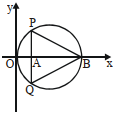
In the circle given below, let $OA =1$ unit, $OB =13$ unit and $PQ \perp OB$. Then, the area of the triangle $PQB$ (in square units) is
Point of intersection of the diagonals of square is at origin and coordinate axis are drawn along the diagonals. If the side is of length $a$, then one which is not the vertex of square is
Let a line perpendicular to the line $2 x-y=10$ touch the parabola $y^2=4(x-9)$ at the point $P$. The distance of the point $\mathrm{P}$ from the centre of the circle $x^2+y^2-14 x-8 y+56=0$ is ...........
If the sum of the binomial coefficients of the expansion $\Big(2\text{x}+\frac{1}{\text{x}}\Big)^{\text{n}}$ is equal to $256,$ then the term independent of $x$ is:
Let $z _{1}$ and $z _{2}$ be two complex numbers such that $\overline{ z }_{1}=i \overline{ z }_{2}$ and $\arg \left(\frac{ z _{1}}{\overline{ z }_{2}}\right)=\pi$. Then
Let ${\left( { - \,2\, - \,\frac{1}{3}\,i} \right)^3} = \frac{{x \,+ \,iy}}{{27}}(i\, = \,\sqrt { - 1} ),$ where $x$ and $y$ are real numbers, then $y -x$ equals