MCQ
$\mathop {\lim }\limits_{x \to 0} {\left( {\frac{{1 + 5{x^2}}}{{1 + 3{x^2}}}} \right)^{1/{x^2}}} = $
  • ${e^2}$
  • B
    $e$
  • C
    ${e^{ - 2}}$
  • D
    ${e^{ - 1}}$

Answer

Correct option: A.
${e^2}$
a
(a) $\mathop {\lim }\limits_{x \to 0} \,{\left( {\frac{{1 + 5{x^2}}}{{1 + 3{x^2}}}} \right)^{1/{x^2}}} = A$

$ \Rightarrow \;{\log _e}A\; = \;\mathop {\lim }\limits_{x \to 0} \frac{1}{{{x^2}}}\log \;\left( {1 + \frac{{2{x^2}}}{{1 + 3{x^2}}}} \right)$

$ = \mathop {\lim }\limits_{x \to 0} \frac{1}{{{x^2}}}\left[ {\frac{{2{x^2}}}{{1 + 3{x^2}}} - \frac{1}{2}\left( {\frac{{2{x^2}}}{{1 + 3{x^2}}}} \right)\;\; + \;\;...} \right]$

$ = \;\mathop {\lim }\limits_{x \to 0} \left[ {\frac{2}{{1 + 3{x^2}}} - \frac{1}{2}\;\;\frac{{2{x^2}}}{{{{(1 + 3{x^2})}^2}}}\;\; + \;\;...} \right]\;\; = \;\;2$

$\therefore \;A\; = \;{e^2}$

Need a full question paper?

Generate a complete, print-ready paper with questions like this in minutes — across 16+ boards, with answer keys.
Start Generating Free

Similar questions

If the system of linear equations :
$
\begin{array}{l}
x+y+2 z=6, \\
2 x+3 y+a z=a+1, \\
-x-3 y+b z=2 b,
\end{array}
$
where $a , b \in R$, has infinitely many solutions, then $7 a+3 b$ is equal to :
$\lim\limits_{x \rightarrow 2} \frac{3^{x}+3^{3-x}-12}{3^{-x / 2}-3^{1-x}}$ is equal to
If $f(x) = {x^2} + 2bx + 2{c^2}$ and $g(x) = - {x^2} - 2cx + {b^2}$ such that min $f(x) > $ max $g(x)$, then the relation between $ b$  and $c $ is
The vectors $b$   and $ c$   are in the direction of north-east and north-west respectively and $ |b|=|c|= 4$ . The magnitude and direction of the vector  $d = c - b$ , are
If ${b_1}{b_2} = 2$ $({c_1} + {c_2})$, then at least one of the equations ${x^2} + {b_1}x + {c_1} = 0$ and ${x^2} + {b_2}x + {c_2} = 0$ has
If $f(x) = \left\{ \begin{array}{l}({x^2}/a) - a,\;\;{\rm{when}}\;x < a\\\;\;\;\;\;\;\;\;\;\;\;0,\;\;{\rm{when}}\;x = a{\rm{,}}\\a - ({x^2}/a),\;\;{\rm{when\,\, }}x > a\end{array} \right.$ then
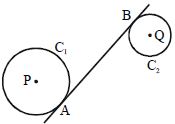
In the figure shown, radius of circle $C_1$ be $ r$ and that of $C_2$ be $\frac{r}{2}$ , where $r= \frac {1}{3} PQ,$ then length of $AB$ is (where $P$ and $Q$ being centres of $C_1$ $\&$ $C_2$ respectively)
The coefficients $a, b, c$ in the quadratic equation $ax ^2+ bx + c = 0$ are chosen from the set $\{1, 2, 3, 4, 5, 6, 7, 8\}$. The probability of this equation having repeated roots is :
$\lim _{t \rightarrow 0}\left(1^{\frac{1}{\sin ^2 t}}+2^{\frac{1}{\sin ^2 t}}+\ldots .+n^{\frac{1}{\sin ^2 t}}\right)^{\sin ^2 t}$ is equal to $.......$
The solutions of the quadratic equation ${(3|x| - 3)^2} = |x| + 7$ which belongs to the domain of definition of the function $y = \sqrt {x(x - 3)} $ are given by