Question
Maximize Z = 4x + 3y
Subject to
$3\text{x}+4\text{y}\leq24$
$8\text{x}+6\text{y}\leq48$
$\text{x}\leq5$
$\text{y}\leq5$
$\text{x},\text{y}\geq0$
Answer


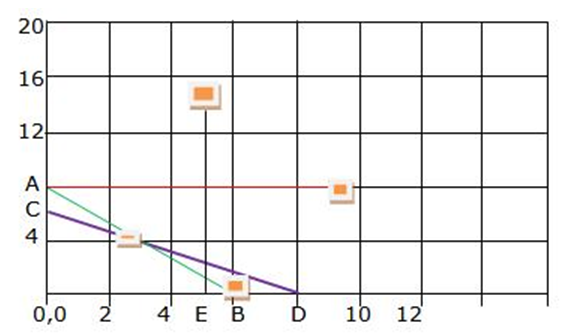
$\text{3x}+\text{4y }\leq24\ ;$ when x = 0, y = 6 & when y = 0, x = 8, line AB
$\text{8x}+\text{6y }\leq48\ ;$ when x = 0, y = 8 & when y = 0, x = 8, line CD
Plotting $\text{x}\leq5$ given line EF; Plotting $\text{y}\leq6$ given line AG
The feasible area is 0, 0 - C - H - G - E
Corner point Value of Z = 4x + 3y
0, 0 0
0, 6 18
3.4, 3.4 24
5, 1 23
5, 0 20
The maximum of Z = 4x + 3y, occurs at x = 3.4, y = 3.4

Need a full question paper?

Generate a complete, print-ready paper with questions like this in minutes — across 16+ boards, with answer keys.

Start Generating Free

Similar questions

Solve the following differential equation
$\frac{\text{dy}}{\text{dx}}+\frac{1+\text{y}^2}{\text{y}}=0$
A diet for a sick person must contain at least $4000$ units of vitamins, $50$ units of minerals and $1400$ units of calories. Two foods $A$ and $B$ are available at a cost of Rs. $5$ and Rs. $4$ per unit respectively. One unit of the food A contains $200$ units of vitamins, $1$ unit of minerals and $40$ units of calories, while one unit of the food $B$ contains $100$ units of vitamins, $2$ units of minerals and $40$ units of calories. Find what combination of the foods $A$ and $B$ should be used to have least cost, but it must satisfy the requirements of the sick person. Form the question as LPP and solve it graphically.
Using differentials, find the approximate values of the following:
$(0.007)^{\frac{1}{3}}$
Solve the following differential equation:
$(\text{x}^2-2\text{xy})\text{dy}+(\text{x}^2-3\text{xy}+2\text{y}^2)\text{dx}=0$
Find non-zero values of x satisfying the matrix equation:$\text{x}\begin{bmatrix}2\text{x}&2\\3&\text{x}\end{bmatrix}+2\begin{bmatrix}8&5\text{x}\\4&4\text{x}\end{bmatrix}=2\begin{bmatrix}(\text{x}^2+8)&24(10)&6\text{x}\end{bmatrix}$
Show that the vectors $\vec{\text{a}},\ \vec{\text{b}},\ \vec{\text{c}}$ given by $\vec{\text{a}}=\hat{\text{i}}+2\hat{\text{j}}+3\hat{\text{k}},\ \vec{\text{b}}=2\hat{\text{i}}+\hat{\text{j}}+3\hat{\text{k}}$ and $\vec{\text{c}}=\hat{\text{i}}+\hat{\text{j}}+\hat{\text{k}}$ are non-coplanar. Express vector $\vec{\text{d}}=2\hat{\text{i}}-\hat{\text{j}}-3\hat{\text{k}}$ as a linear combination of the vectors $\vec{\text{a}},\ \vec{\text{b}}\text{ and }\vec{\text{c}}$.
The sum of three numbers is $2$. If twice the second number is added to the sum of first and third, the sum is $1$. By adding second and third number to five times the first number, we get $6$. Find the three numbers by using matrices.
Differentiate the following functions with respect to x:
$\log\Big(\frac{\sin\text{x}}{1+\cos\text{x}}\Big)$
A ladder 13m long leans against a wall. The foot of the ladder is pulled along the ground away from the wall, at the rate of 1.5m/ sec. How fast is the angle $\theta$ between the ladder and the ground is changing when the foot of the ladder is 12m away from the wall.
Find the maximum and the minimum values, if any, without using derivaives of the following functions:$f(x) = 16x^2 - 16x + 28$ on $R$.