Question
Maximize Z = 50x + 30y
Subject to
$2\text{x}+\text{y}\leq18$
$3\text{x}+2\text{y}\leq34$
$\text{x},\text{y}\geq0$
Answer

First, we will convert the given inequations into equations, we obtain the following equations:
2x + y = 18, 3x + 2y = 34
Region represented by 2x + y ≥ 18:
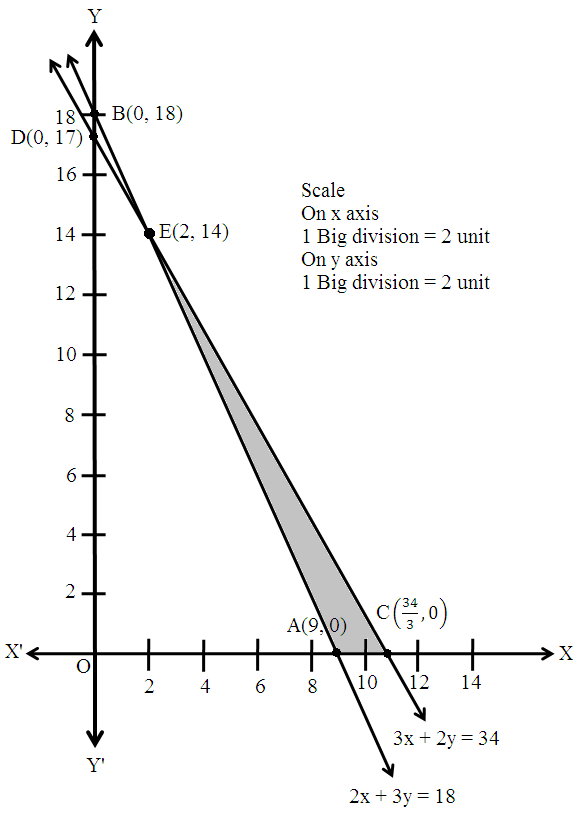
The line 2x + y = 18 meets the coordinate axes at A(9, 0) and B(0, 18) respectively. By joining these points we obtain the line 2x + y = 18.
Clearly (0,0) does not satisfies the inequation 2x + y ≥ 18.
So,the region in xy plane which does not contain the origin represents the solution set of the inequation 2x + y ≥ 18.
Region represented by 3x + 2y ≤ 34:
The line 3x + 2y = 34 meets the coordinate axes at $\text{C}\Big(\frac{34}{3},0\Big)$ and D(0, 17) respectively. By joining these points we abtain the line 3x + 2y = 34.
Clearly (0. 0) satisfies the inequation 3x + 2y ≤ 34. So, the region containing the origin represents the silution set of the inequation 3x + 2y ≤ 34.
The corner of the feasible region are A(9, 0), $\text{C}\Big(\frac{34}{3},0\Big)$ and E(2, 14).

The values of Z at these corner points are as follows.
$\text{Corner point}$
$\text{Z}=50\text{x}+30\text{y}$
$\text{A}(9, 0)$
$50\times9+3\times0=450$
$\text{C}\Big(\frac{34}{3},0\Big)$
$50\times\frac{34}{3}+30\times0=\frac{1700}{3}$
$\text{E}(2, 14)$
$50\times2+30\times14=520$
Therefore, the maximum value of Z $\frac{1700}{3}$ is at the point $\Big(\frac{34}{3},0\Big)$.
Hence, $\text{x}=\frac{34}{3}$ and $\text{y}=0$ is the optimal solution of the given LPP.
Thus, the optimal value of Z is $\frac{1700}{3}$.

Need a full question paper?

Generate a complete, print-ready paper with questions like this in minutes — across 16+ boards, with answer keys.

Start Generating Free

Similar questions

Find the equation of the plane through the intersection of the planes 3x - 4y + 5z = 10 and 2x + 2y - 3z = 4 and parallel to the line x = 2y = 3z.
Solve the following differential equation:
$\cos^{2}\text{x}\frac{\text{dy}}{\text{dx}}+\text{y}=\tan\text{x}.$
A bag contains 4 white and 5 black balls and another bag contains 3 white and 4 black balls. A ball is taken out from the first bag and without seeing its colour is put in the second bag. A ball is taken out from the latter. Find the probability that the ball drawn is white.
If the area enclosed by the parabolas $y^2 - 16ax$ and $x^2 = 16ay, a > 0$ is $\frac{1024}{3}$ square units, find the value of a.
Find the intervals in which $f(x) = (x + 2)e^{-x}$ is increasing or decreasing.
Differentiate $\sqrt{\tan\text{ x}}$ w.r.t. x from first principles.
Find $x, y, z$ if $\text{A}=\begin{bmatrix}0&2\text{y}&\text{z}\\\text{x}&\text{y}&-\text{z}\\\text{x}&-\text{y}&\text{z}\end{bmatrix}$ satisfies $A′ = A^{-1}$.
Prove that $\Big(\frac{\text{x}}{\text{a}}\Big)^\text{n}+\Big(\frac{\text{y}}{\text{b}}\Big)^\text{n}=2$ touches the straight line $\frac{\text{x}}{\text{a}}+\frac{\text{y}}{\text{b}}=2$ for all n $\in$ N, at all the point (a, b).
A rubber company is engaged in producing three types of tyres A, B and C. Each type requires processing in two plants, Plant I and Plant II. The capacities of the two plants, in number of tyres per day, are as follows:
Plant
A
B
C
I
50
100
100
II
60
60
200
The monthly demand for tyre A, B and C is 2500, 3000 and 7000 respectively. If plant I costs Rs. 2500 per day, and plant II costs Rs. 3500 per day to operate, how many days should each be run per month to minimize cost while meeting the demand? Formulate the problem as LPP.
Find the inverse of the following matrices by using elementry row transformation:$\begin{bmatrix} -1 & 1 & 2 \\ 1 & 2 & 3 \\ 3 & 1 & 1 \end{bmatrix}$