Maximum amplitude(in $cm$) of $SHM$ so block A will not slip on block $B , K =100 N / m$
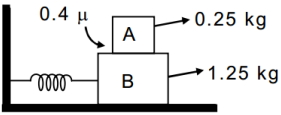
AIIMS 2019, Diffcult
Download our app for free and get started
The expression of force is given as,
$F = m \omega^{2} A =\mu mg$
So,
$A =\frac{\mu g }{\omega^{2}}$ And $\omega=\sqrt{\frac{ K }{ m }}$
So,
$\omega=\sqrt{\frac{100}{1.5}}$
Substitute the values.
$A =\frac{(0.4)(9.8)}{\left(\sqrt{\frac{100}{1.5}}\right)^{2}}$
$=6\, cm$

Download our appand get started for free
Experience the future of education. Simply download our apps or reach out to us for more information. Let's shape the future of learning together!No signup needed.*
Similar Questions
- 1The acceleration of a particle performing S.H.M. is at a distance of $3\; cm$ from the mean position is $ 12\,cm/sec^2 $. Its time period is ..... $\sec$View Solution
- 2Two simple pendulum whose lengths are $1\,m$ and $121\, cm$ are suspended side by side. Their bobs are pulled together and then released. After how many minimum oscillations of the longer pendulum will the two be in phase againView Solution
- 3The displacement of a particle varies according to the relation $x = 3 \ sin\ 100t + 8\ cos^2\ 50t$ . Which of the following is incorrect about this motionView Solution
- 4Function $x$ = $A sin^2 wt + B cos^2 wt + C sin wt \ cos wt$ does not represents $SHM$ for this conditionView Solution
- 5The displacement of a particle moving in $S.H.M.$ at any instant is given by $y = a\sin \omega t$. The acceleration after time $t = \frac{T}{4}$ is (where $T$ is the time period)View Solution
- 6A particle executes simple harmonic motion. Its amplitude is $8 \,cm$ and time period is $6 \,s$. The time it will take to travel from its position of maximum displacement to the point corresponding to half of its amplitude, is ............. $s$View Solution
- 7View SolutionThe total energy of a particle, executing simple harmonic motion is
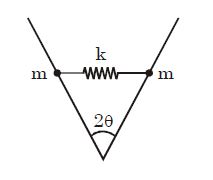
- 8Two particles of mass $m$ are constrained to move along two horizontal frictionless rails that make an angle $2\theta $ with respect to each other. They are connected by a spring with spring constant $k$ . The angular frequency of small oscillations for the motion where the two masses always stay parallel to each other (that is the distance between the meeting point of the rails and each particle is equal) isView Solution
- 9The particle executing $SHM$ of amplitude $'a'$ has displacement $-\frac {a}{2}$ at $t = \frac {T}{4}$ and a positive velocity. Find the initial phase of particleView Solution
- 10A particle starts simple harmonic motion from the mean position. Its amplitude is $a$ and total energy $E$. At one instant its kinetic energy is $3E/4.$ Its displacement at that instant isView Solution