MCQ
Maximum density of ${H_2}O$ is at the temperature .......... $^oF$
- A$32$
- ✓$39.2$
- C$42$
- D$4$
Also $\frac{C}{5} = \frac{{F - 32}}{9}$ $⇒$ $\frac{4}{5} = \frac{{F - 32}}{9}$ $\Rightarrow$ $F = 39.2^\circ F$
Generate a complete, print-ready paper with questions like this in minutes — across 16+ boards, with answer keys.
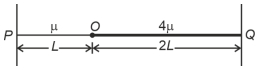
$(A)$ With a node at $O$, the minimum frequency of vibration of the composite string is $v_0$
$(B)$ With an antinode at $O$, the minimum frequency of vibration of the composite string is $2 v_0$
$(C)$ When the composite string vibrates at the minimum frequency with a node at $O$, it has $6$ nodes, including the end nodes
$(D)$ No vibrational mode with an antinode at $O$ is possible for the composite string