MCQ
Maximum useable frequency (MUF) in F-region layer is x, when the critical frequency is 60 MHz and the angle of incidence is 70°. Then x is
  • A
     150 MHz
  • B
     170 MHz
  •  175 MHz
  • D
     190 MHz

Answer

Correct option: C.
 175 MHz
 175 MHz

Need a full question paper?

Generate a complete, print-ready paper with questions like this in minutes — across 16+ boards, with answer keys.
Start Generating Free

Similar questions

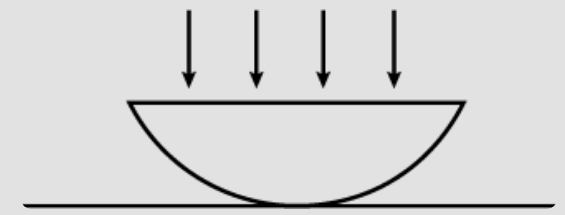
A thin slice is cut out of a glass cylinder along a plane parallel to its axis. The slice is placed on a flat glass plae as shown in figure. The observed interference fringes from this combination shall be:
A triangular loop of side $l$ carries a current $I$. It is placed in a magnetic field $B$ such that the plane of the loop is in the direction of $B$. The torque on the loop is
The waves which are electromagnetic in nature are:
Which of the following is the fusion reaction
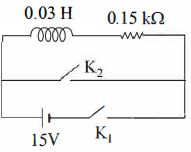
An inductor $(L = 0.03\;H)$ and a resistor $(R = 0.15 k\Omega )$ are connected in series to a battery of $15\;V$ $EMF$ in a circuit shown below. The key $K_1$ has been kept closed for a long time. Then at $t = 0$, $K_1$ is opened and key $K_2$ is closed simultaneously. At $t = 1 \;ms$, the current in the circuit will be ........... $mA$. (${e^5} \cong 150)$
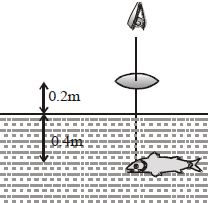
A smal fish $0.4\,m$ below the surface of a lake , is viewed through a simple converging lesn of focal length $3\,m.$ The lens is kept at $0.2\, m$ above the water surface such that fish lies on the optical axis of the lens. The image of the fish seen by oserver will be at  $\left( {{\mu _{water}} = \frac{4}{3}} \right)$
The wavelength of the light used in Young's double slit experiment is $\lambda $. The intensity at a point on the screen is $I$, where the path difference is $\lambda /6$. If $I_0$ denotes the maximum intensity, then the ratio of $I$ and $I_0$ is
When the nucleus of a radioactive element emits an alpha particle, the atomic number is decreased by:
The momentum of a photon is $2 \times {10^{ - 16}}gm-cm/sec$. Its energy is
An electron is revolving round a proton, producing a magnetic field of $16 \text{ weber/m}^2$ in a circular orbit of radius $1 \mathring A$ . It’s angular velocity will be