Question
Maximum $Z = 10x + 6y$
Subject to
$3\text{x}+\text{y}\leq12$
$2\text{x}+5\text{y}\leq34$
$\text{x},\text{y}\geq0$
Answer

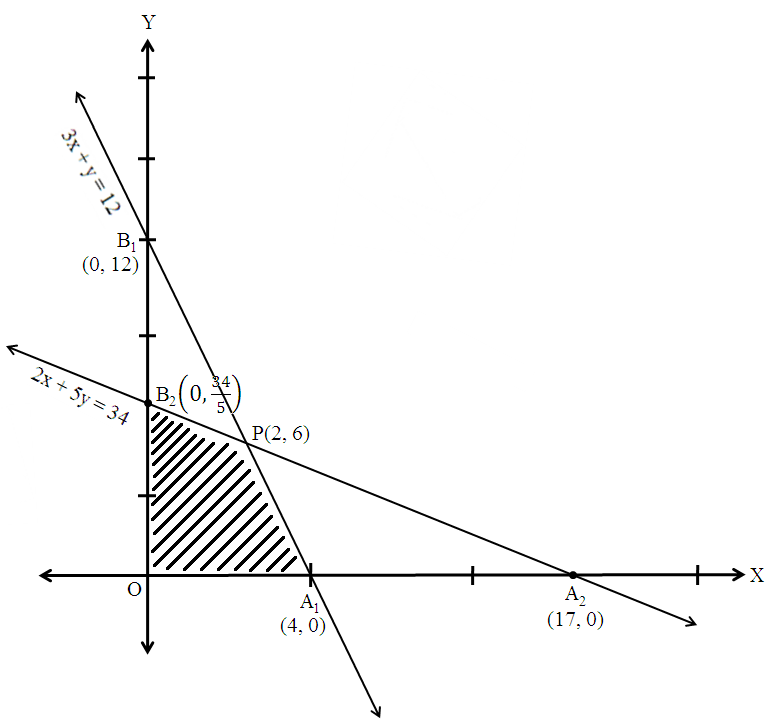
Converting the given inequations in to equations.
$3x + y = 12, 2x + 5y = 34, x = y = 0$


Region represented by $3\text{x}+\text{y}\leq12$:
Line $3x + y = 12$ meets the coordinate axes at $A_1(4, 0)$ and $B(0, 12)$, clearly, $(0, 0)$ satisfies $3\text{x}+\text{y}\leq12$, so, region containing origin is represented by $3\text{x}+\text{y}\leq12$ in xy-plane.
Region represented by $2\text{x}+5\text{y}\leq34$:
Line $2x +y = 34$ meets coordinate axes at $A_2$_$(17, 0)$ and $\text{B}\Big(0,\frac{34}{5}\Big)$ clearly, $(0, 0)$ satisfies the $2\text{x}+5\text{y}\leq34$ so, region containing origin represents $2\text{x}+5\text{y}\leq34$ in xy-plane.
Region represented by $\text{x},\text{y}\geq0$:
It represent the first quadrant in xy-plane
Therefore, shaded area $OA_1PB_2$ is the feasible region.
The coordinate of $P(2, 6)$ is obtained by solving $2x + 5y = 34$ and $3x + y = 12$
The value of $Z = 10x + 6y at$
$\text{O}(0, 0) = 10(0) + 6(0) = 0$
$\text{A}_1(4, 0) = 10(4) + 6(0) = 40$
$\text{P}(2, 6) = 10(2) + 6(6) = 56$
$\text{B}_2\Big(0,\frac{34}{5}\Big)=10(0)+6\Big(\frac{34}{5}\Big)=\frac{204}{5}=40\frac{4}{5}$
Hence, maximum $Z = 56 at x = 2, y = 6.$

Need a full question paper?

Generate a complete, print-ready paper with questions like this in minutes — across 16+ boards, with answer keys.

Start Generating Free

Similar questions

Show that the height of the cone of maximum volume that can be inscribed in a sphere of radius 12cm is 16cm.
Prove that:
$\begin{vmatrix}\text{a}+\text{b}+2\text{c}&\text{a}&\text{b}\\\text{c}&\text{b}+\text{c}+2\text{a}&\text{b}\\\text{c}&\text{a}&\text{c}+\text{a}+2\text{b} \end{vmatrix}=2(\text{a}+\text{b}+\text{c})^3$
Differentiate the following functions with respect to x:
$\cos^{-1}\Big\{\sqrt{\frac{1+\text{x}}{2}}\Big\},-1<\text{x}<1$
Evaluate the following integrals:
$\int\limits^{\frac{3}{2}}_0\big|\text{x}\cos\pi\text{x}\big|\text{dx}$
Show that the function $\text{f(x)}\begin{cases}\text{x}^\text{m}\sin(\frac{1}{\text{x}}), &\text{x}\neq0 \\0 ,& \text{x}=0\end{cases}$
Differential at x = 0, if m > 1
Coloured balls are distributed in three bags as shown in the following table:
Bag Colour of the ball
Black White Red
I 1 2 3
II 2 4 1
III 4 5 3
A bag is selected at random and then two balls are randomly drawn from the selected bag. They happen to be black and red. What is the probability that they came from bag I?
Prove that the lines through A(0, -1, -1) and B(4, 5, 1) intersects the line through C(3, 9, 4) and D(-4, 4, 4). Also, find their point of intersection.
Two schools $P$ and $Q$ want to award their selected students on the values of Discipline, Politeness and Punctuality. The school $P$ wants to award ₹ $x$ each, ₹ $y$ each and ₹ $z$ each for the three respective values to its $3, 2$ and $1$ students with a total award money of ₹ $1,000.$ School $Q$ wants to spend ₹ $1,500$ to award its $4, 1$ and $3$ students on the respective values $($by giving the same award money for the three values as before$).$ If the total amount of awards for one prize one each value is ₹ $600,$ using matrices, find the award money for each value. Apart from the above three values, suggest one more value for awards.
The function $y = a \log x + bx^2 + x$ has extreme values at $x = 1$ and $x = 2.$ Find $a$ and $b.$
Find matrix A such that
$\begin{bmatrix} 2& -1\$0.3em] 1 & 0 \$0.3em] -3 & 4 \end{bmatrix}\text{A}=\begin{bmatrix} -1& -8\$0.3em] 1 & -2 \$0.3em] 9 & 22 \end{bmatrix}$