Question
Maximum Z = 15x + 10y
Subject to
$3\text{x}+2\text{y}\leq80$
$2\text{x}+3\text{y}\leq70$
$\text{x},\text{y}\geq0$
Answer

First, we will convert the given inequations into equations, we obtain the following equations:

3x + 2y = 80, 2x + 3y = 70, x = 0 and y=0

Region represented by $3\text{x}+2\text{y}\leq80:$

The line 3x + 2y = 80 meets the coordinate axes at $\text{A}\Big(\frac{80}{3},0\Big)$ and B(0, 40) respectively.

By joining these points we obtain the line 3x + 2y = 80.

Clearly (0,0) satisfies the inequation $3\text{x}+2\text{y}\leq80$.

So, the region containing the origin represents the solution set of the inequation $3\text{x}+2\text{y}\leq80$.

Region represented by $2\text{x}+3\text{y}\leq70:$

The line 2x + 3y = 70 meets the coordinate axes at C(35, 0) and $\text{D}\Big(0,\frac{70}{3}\Big)$ respectively.

By joining these points we obtain the line $2\text{x}+3\text{y}\leq70$.

Clearly (0,0) satisfies the inequation $2\text{x}+3\text{y}\leq70$.

So, the region containing the origin represents the solution set of the inequation $2\text{x}+3\text{y}\leq70$.

Region represented by $\text{x}\geq0$ and $\text{y}\geq0$.

Since, every point in the first quadrant satisfies these inequations.

So, the first quadrant is the region represented by the inequations $\text{x}\geq0$ and $\text{y}\geq0$.

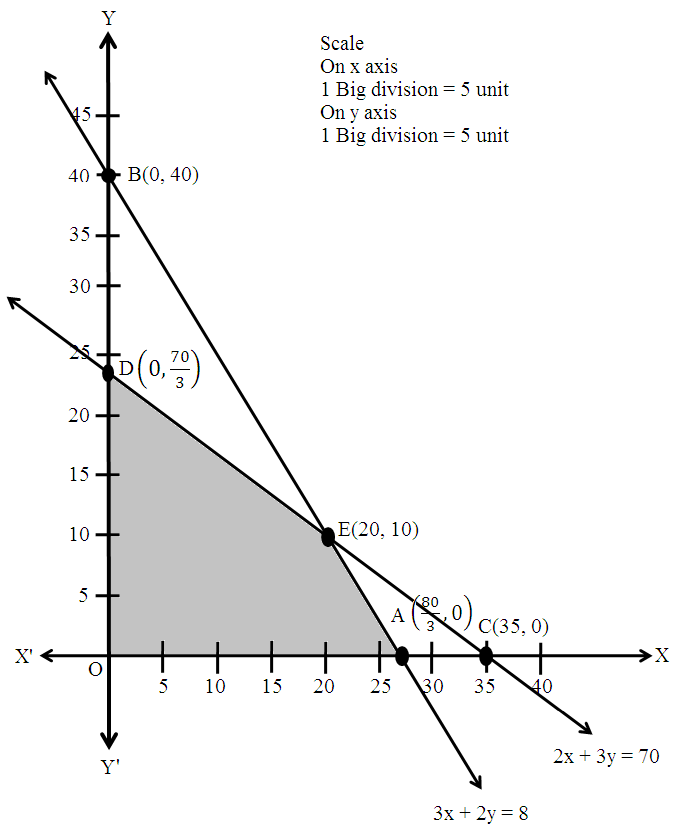
The feasible region determined by the system of constraints $3\text{x}+2\text{y}\leq80$, $2\text{x}+3\text{y}\leq70$, $\text{x}\geq0$ and $\text{y}\geq0$ are as follows.


The corner points of the feasible are O(0, 0), $\text{A}\Big(\frac{80}{3},0\Big)\text{E}(20,10)$ and $\text{D}\Big(0,\frac{700}{3}\Big)$ .

The values of Z at these corner point are as follows.
$\text{Corner point}$
$\text{Z}=15\text{x}+10\text{y}$
$\text{O}(0, 0)$
$15\times0+10\times0=0$
$\text{A}\Big(\frac{80}{3},0\Big)$
$15\times\frac{80}{3}+10\times0=400$
$\text{E}(20, 10)$
$15\times20+10\times10=400$
$\text{D}\Big(0,\frac{70}{3}\Big)$
$15\times0+10\times\frac{70}{3}=\frac{700}{3}$
We see that maximum value of the objective functioin Z is 400 which is at $\text{A}\Big(\frac{80}{3},0\Big)$ and E(20, 10).

Thus, the optimal value of Z is 400.

Need a full question paper?

Generate a complete, print-ready paper with questions like this in minutes — across 16+ boards, with answer keys.

Start Generating Free

Similar questions

A small manufacturer has employed 5 skilled men and 10 semi-skilled men and makes an article in two qualities deluxe model and an ordinary model. The making of a deluxe model requires 2 hrs. work by a skilled man and 2 hrs. work by a semi-skilled man. The ordinary model requires 1 hr by a skilled man and 3 hrs. by a semi-skilled man. By union rules no man may work more than 8 hrs per day. The manufacturers clear profit on deluxe model is Rs. 15 and on an ordinary model is Rs. 10. How many of each type should be made in order to maximize his total daily profit.
If $\vec{\text{a}}=2\hat{\text{i}}-3\hat{\text{j}}+\hat{\text{k}},\vec{\text{b}}=-\hat{\text{i}}+\hat{\text{k}},\vec{\text{c}}=2\hat{\text{j}}-\hat{\text{k}}$are three vectors, find the aera of the parallelogram having diagonals $\big(\vec{\text{a}}+\vec{\text{b}}\big)$ and $\big(\vec{\text{b}}+\vec{\text{c}}\big).$
Solve the following system of equations by matrix method:
$6x - 12y + 25z = 4$
$4x + 15y - 20z = 3$
$2x + 18y + 15z = 10$
The contents of three urns are as follows:
Urn 1 : 7 white, 3 black balls,
Urn 2 : 4 white, 6 black balls,
Urn 3 : 2 white, 8 black balls.
One of these urns is chosen at random with probabilities 0.20, 0.60 and 0.20 respectively. From the chosen urn two balls are drawn at random without replacement. If both these balls are white, what is the probability that these came from urn 3?
Prove that the area the region bounded by $\text{y}=\sqrt{\text{x}}, $and x = 2y + 3 in the first and x-asis.
Evaluate the following intregals:
$\int\frac{2\text{x}+1}{\sqrt{\text{x}^2+2\text{x}-1}}\ \text{dx}$
If function $f: R \rightarrow R , f(x)=x^2+2$ and $g: R \rightarrow R$ $g(x)=\frac{x}{x-1}, x \neq 1$ then find $f o g$ and $g o f$ and also find $( fog )(2)$ and $( gof )(-3)$ ?
If $\text{y}=\log\frac{\text{x}^2+\text{x}+1}{\text{x}^2-\text{x}+1}+\frac{2}{\sqrt{3}}\tan^{-1}\Big(\frac{\sqrt{3}\text{x}}{1-\text{x}^2}\Big),$ find $\frac{\text{dy}}{\text{dx}}$
If A = $\left[\begin{array}{lll} {3} & {\sqrt{3}} & {2} \\ {4} & {2} & {0} \end{array}\right] \text { and } B=\left[\begin{array}{rrr} {2} & {-1} & {2} \\ {1} & {2} & {4} \end{array}\right]$ verify that
  1. (A′)′ = A
  2. (A + B)′ = A′ + B′
  3. (kB)′ = kB′, where k is any constant.
If $x = a \cos^3 \theta$ and $y = a \sin^3 \theta$, then find the value of $\frac{\text{f}^{2}\text{y}}{\text{dx}}\text{at}\theta = \frac{\pi}{6}.$