Question
Maximum Z = 15x + 10y
Subject to
$3\text{x}+2\text{y}\leq80$
$2\text{x}+3\text{y}\leq70$
$\text{x},\text{y}\geq0$
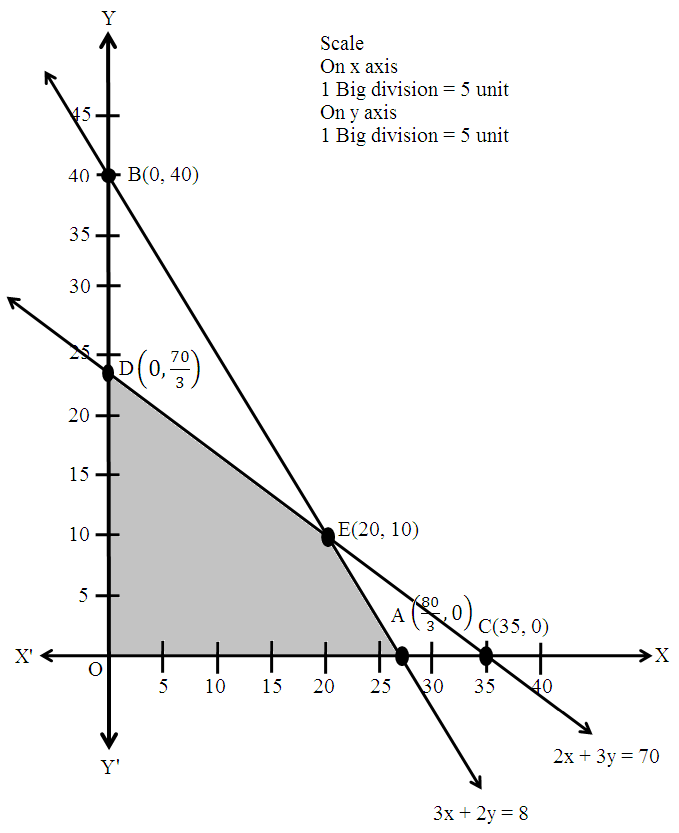
Answer

First, we will convert the given inequations into equations, we obtain the following equations:

3x + 2y = 80, 2x + 3y = 70, x = 0 and y=0

Region represented by $3\text{x}+2\text{y}\leq80:$

The line 3x + 2y = 80 meets the coordinate axes at $\text{A}\Big(\frac{80}{3},0\Big)$ and B(0, 40) respectively.

By joining these points we obtain the line 3x + 2y = 80.

Clearly (0,0) satisfies the inequation $3\text{x}+2\text{y}\leq80$.

So, the region containing the origin represents the solution set of the inequation $3\text{x}+2\text{y}\leq80$.

Region represented by $2\text{x}+3\text{y}\leq70:$

The line 2x + 3y = 70 meets the coordinate axes at C(35, 0) and $\text{D}\Big(0,\frac{70}{3}\Big)$ respectively.

By joining these points we obtain the line $2\text{x}+3\text{y}\leq70$.

Clearly (0,0) satisfies the inequation $2\text{x}+3\text{y}\leq70$.

So, the region containing the origin represents the solution set of the inequation $2\text{x}+3\text{y}\leq70$.

Region represented by $\text{x}\geq0$ and $\text{y}\geq0$.

Since, every point in the first quadrant satisfies these inequations.

So, the first quadrant is the region represented by the inequations $\text{x}\geq0$ and $\text{y}\geq0$.

The feasible region determined by the system of constraints $3\text{x}+2\text{y}\leq80$, $2\text{x}+3\text{y}\leq70$, $\text{x}\geq0$ and $\text{y}\geq0$ are as follows.


The corner points of the feasible are O(0, 0), $\text{A}\Big(\frac{80}{3},0\Big)\text{E}(20,10)$ and $\text{D}\Big(0,\frac{700}{3}\Big)$ .

The values of Z at these corner point are as follows.
$\text{Corner point}$
$\text{Z}=15\text{x}+10\text{y}$
$\text{O}(0, 0)$
$15\times0+10\times0=0$
$\text{A}\Big(\frac{80}{3},0\Big)$
$15\times\frac{80}{3}+10\times0=400$
$\text{E}(20, 10)$
$15\times20+10\times10=400$
$\text{D}\Big(0,\frac{70}{3}\Big)$
$15\times0+10\times\frac{70}{3}=\frac{700}{3}$
We see that maximum value of the objective functioin Z is 400 which is at $\text{A}\Big(\frac{80}{3},0\Big)$ and E(20, 10).

Thus, the optimal value of Z is 400.

Need a full question paper?

Generate a complete, print-ready paper with questions like this in minutes — across 16+ boards, with answer keys.

Start Generating Free

Similar questions

The adjacent sides of a parallelogram are represented by the vectors $\vec{\text{a}}=\hat{\text{i}}+\hat{\text{j}}-\hat{\text{k}}$ and $\vec{\text{b}}=-2\hat{\text{i}}+\hat{\text{j}}+2\hat{\text{k}}$. Find the unit vectors parallel to the diagonals of the parallelogram.
If $\text{A}=\begin{bmatrix}1&1\\0&1\end{bmatrix},$ prove that $\text{A}^\text{n}=\begin{bmatrix}1&\text{n}\\0&1\end{bmatrix}$ for all positive integers n.
Find the value of $\tan^{-1}\Big(\frac{\text{x}}{\text{y}}\Big)-\tan^{-1}\Big(\frac{\text{x-y}}{\text{x+y}}\Big)$
A cottage industry manufactures pedestal lamps and wooden shades, each requiring the use of grinding/cutting machine and sprayer. It takes 2 hours on the grinding/cutting machine and 3 hours on the sprayer to manufacture a pedestal lamp while it takes 1 hour on the grinding/cutting machine and 2 hours on the sprayer to manufacture a shade. On any day, the sprayer is available for at most 20 hours and the grinding/cutting machine for at most 12 hours. The profit from the sale of a lamp is Rs. 5.00 and a shade is Rs. 3.00. Assuming that the manufacturer can sell all the lamps and shades that he produces, how should he schedule his daily production in order to maximise his profit?
Differentiate $\sqrt{\tan\text{ x}}$ w.r.t. x from first principles.
Show that the points A(1, -2, -8), B(5, 0, -2) and C(11, 3, 7) are collinear, and find the ratio in which B divides AC.
Solve the following systems of linear equations by cramer's rule:
x - 4y - z = 11,
2x - 5y + 2z = 39,
-3x + 2y + z = 1
$\int\bigg[\log \log \text{x} + \frac{1}{(\log \text{x)}^{2}}\bigg]\text{dx}$
Without expanding, show that the values of the following determinant are zero:
$\begin{vmatrix}1&\text{a}&\text{a}^2-\text{bc}\\1&\text{b}&\text{b}^2-\text{ac}\\1&\text{c}&\text{c}^2-\text{ab} \end{vmatrix}$
The sum of three numbers is $2$. If twice the second number is added to the sum of first and third, the sum is $1$. By adding second and third number to five times the first number, we get $6$. Find the three numbers by using matrices.