Question
Maximum Z = 3x + 4y
Subject to
$2\text{x}+2\text{y}\leq80$
$2\text{x}+4\text{y}\leq120$

Answer

We have to maximize Z = 3x + 4y First, we will convert the given inequations into equations, we obtain the following equations: 2x + 2y = 80, 2x + 4y = 120 Region represented by 2x + 2y ≤ 80: The line 2x + 2y = 80 meets the coordinate axes at A(40, 0) and B(0, 40) respectively. By joining these points we obtain the line 2x + 2y = 80. Clearly (0, 0) satisfies the inequation 2x + 2y ≤ 80. So,the region containing the origin represents the solution set of the inequation 2x + 2y ≤ 80. Region represented by 2x + 4y ≤ 120: The line 2x + 4y = 120 meets the coordinate axes at C(60, 0) and D(0, 30) respectively. By joining these points we obtain the line 2x + 4y ≤ 120. Clearly (0, 0) satisfies the inequation 2x + 4y ≤ 120. So,the region containing the origin represents the solution set of the inequation 2x + 4y ≤ 120. The feasible region determined by the system of constraints, 2x + 2y ≤ 80, 2x + 4y ≤ 120 are as follows:
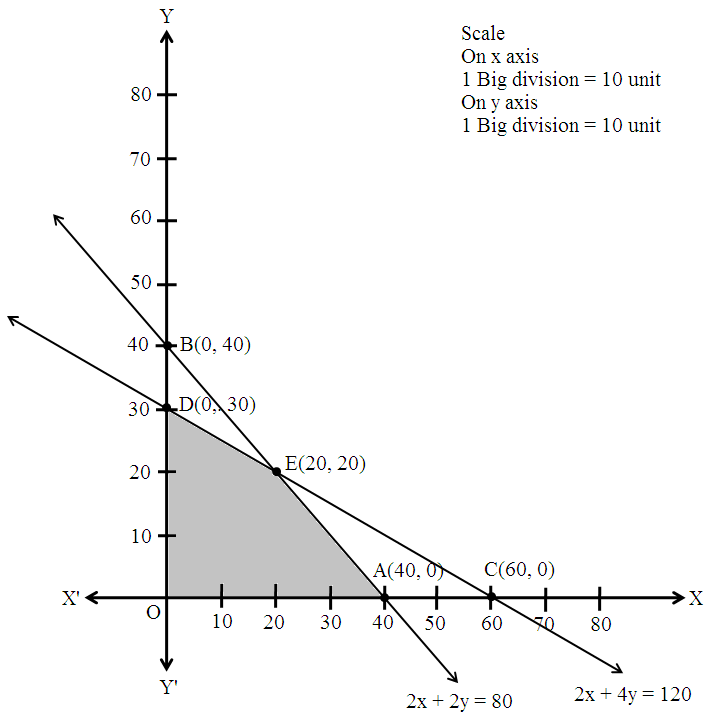
The corner points of the feasible region are O(0, 0), A(40, 0), E(20, 20) and D(0, 30). The values of Z at these corner points are as follows:
Corner point
Z = 3x +4y
O(0, 0)
3 × 0 + 4 × 0 = 0
A(40, 0)
3 × 40 + 4 × 0 = 120
E(20, 20)
3 × 20 + 4 × 20 = 140
D(0, 30)
10 × 0 + 4 × 30 = 120
We see that the maximum value of the objective function Z is 140 which is at E(20, 20) that means at x = 20 and y = 20. Thus, the optimal value of Z is 140.

Need a full question paper?

Generate a complete, print-ready paper with questions like this in minutes — across 16+ boards, with answer keys.

Start Generating Free

Similar questions

Solve the following differential equation
$\text{C}(\text{x})=2+0.15\text{x},\text{C}(0)=100$
If $\text{x}=\cot\text{t and y}=\sin\text{t},$ prove that $\frac{\text{dy}}{\text{dx}}=\frac{1}{\sqrt{3}}\text{ at t}=\frac{2\pi}{3}$
There are two types of fertilizers $F_1$ and $F_2$. $F_1$ consists of $10%$ nitrogen and $6%$ phosphoric acid and ​$F_2$ consists of $5%$ nitrogen and $10%$ phosphoric acid. After testing the soil conditions, a farmer finds the she needs atleast $14$ kg of nitrogen and $14$  kg of phosphoric acid for her crop. If $F_1$ costs Rs 6/kg and $F_2$ costs Rs $5/$kg, determine how much of each type of fertilizer should be used so that the nutrient requirements are met at minimum cost. What is the minimum cost?
Find the coordinates of the foot of the perependicular drawn from the origin to the plane 2x - 3y + 4z - 6 = 0.
Determine the points on the curve $x^2 = 4y$ which are nearest to the point $(0, 5)$.
Find the particular solution of the differential equation $\text{x}\cos\Big(\frac{\text{y}}{\text{x}}\Big)\frac{\text{dy}}{\text{dx}}=\text{y}\cos\Big(\frac{\text{y}}{\text{x}}\Big)+\text{x},$ given that when $\text{x}=1,\text{y}=\frac{\pi}4$.
Find the value of x such that the points A (3, 2, 1), B (4, x, 5), C (4, 2, – 2) and D (6, 5, – 1) are coplanar.
Evaluate:
$\int\limits^{\pi/4}_{0}\bigg(\frac{\sin \text{x} +\cos \text{x}}{3 + \sin 2\text{x}}\bigg)\text{dx}$
Evaluate the following integrals:
$\int\limits_{0}^{\frac{\pi}{2}}\frac{1}{5\cos\text{x}+3\sin\text{x}}\text{ dx}$
If $\text{y}=(\cot^{-1}\text{x})^2$ prove that $\text{y}^2(\text{x}^2+1)^2+2\text{x}(\text{x}^2+1)\text{y}_1=2.$