Question
Maximum Z = 3x + 4y
Subject to
$2\text{x}+2\text{y}\leq80$
$2\text{x}+4\text{y}\leq120$

Answer

We have to maximize Z = 3x + 4y First, we will convert the given inequations into equations, we obtain the following equations: 2x + 2y = 80, 2x + 4y = 120 Region represented by 2x + 2y ≤ 80: The line 2x + 2y = 80 meets the coordinate axes at A(40, 0) and B(0, 40) respectively. By joining these points we obtain the line 2x + 2y = 80. Clearly (0, 0) satisfies the inequation 2x + 2y ≤ 80. So,the region containing the origin represents the solution set of the inequation 2x + 2y ≤ 80. Region represented by 2x + 4y ≤ 120: The line 2x + 4y = 120 meets the coordinate axes at C(60, 0) and D(0, 30) respectively. By joining these points we obtain the line 2x + 4y ≤ 120. Clearly (0, 0) satisfies the inequation 2x + 4y ≤ 120. So,the region containing the origin represents the solution set of the inequation 2x + 4y ≤ 120. The feasible region determined by the system of constraints, 2x + 2y ≤ 80, 2x + 4y ≤ 120 are as follows:
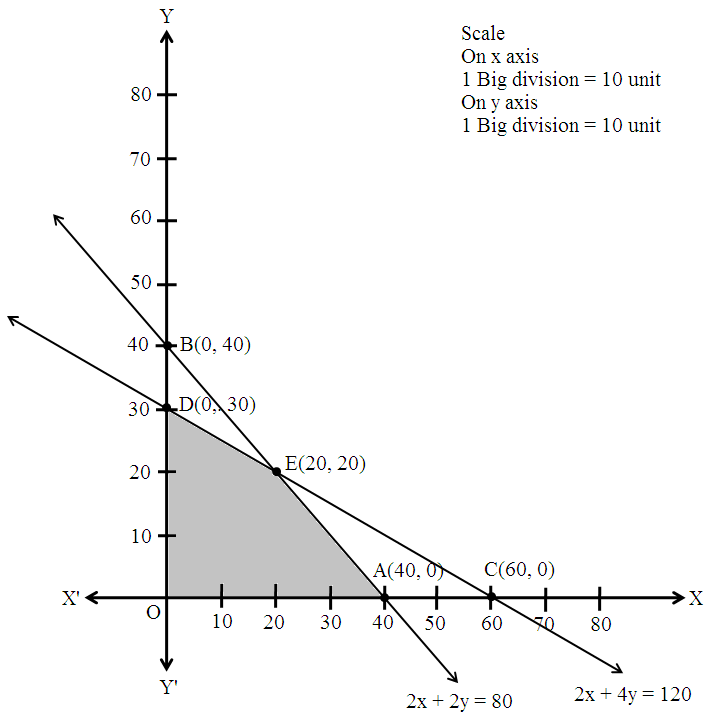
The corner points of the feasible region are O(0, 0), A(40, 0), E(20, 20) and D(0, 30). The values of Z at these corner points are as follows:
Corner point
Z = 3x +4y
O(0, 0)
3 × 0 + 4 × 0 = 0
A(40, 0)
3 × 40 + 4 × 0 = 120
E(20, 20)
3 × 20 + 4 × 20 = 140
D(0, 30)
10 × 0 + 4 × 30 = 120
We see that the maximum value of the objective function Z is 140 which is at E(20, 20) that means at x = 20 and y = 20. Thus, the optimal value of Z is 140.

Need a full question paper?

Generate a complete, print-ready paper with questions like this in minutes — across 16+ boards, with answer keys.

Start Generating Free

Similar questions

If P(A) = 0.4, P(B) = 0.8, $\text{P}\Big(\frac{\text{B}}{\text{A}}\Big)=0.6$. Find $\text{P}\Big(\frac{\text{A}}{\text{B}}\Big)$ and $\text{P}(\text{A}\cap\text{B}).$
Find the general solution of the differential equation $\frac{\text{dy}}{\text{dx}}-{\text{y}}=\cos\text{x}$
If $x^m + y^n = 1,$ Prove that $\frac{\text{dy}}{\text{dx}}=-\frac{\text{my}}{\text{nx}}$
Evaluate the following integrals:$\int\limits^{\frac{\pi}{2}}_0\frac{\tan^{7}\text{x}}{\tan^{7}\text{x}+\cot^7\text{x}}\text{ dx}$
If $l_i, m_i, n_i; i = 1, 2, 3$ denotes the direction cosines of three mutually perpendicular vectors in space, prove that $AA^T = I$, where
$\text{A}=\begin{bmatrix}\text{l}_1&\text{m}_1&\text{n}_1\\\text{l}_2&\text{m}_2&\text{n}_2\\\text{l}_3&\text{m}_3&\text{n}_3 \end{bmatrix}.$
Prove the following identities:
$\begin{vmatrix}\text{x}+\lambda&2\text{x}&2\text{x}\\2\text{x}&\text{x}+\lambda&2\text{x}\\2\text{x}&2\text{x}&\text{x}+\lambda\end{vmatrix}$
$=(5\text{x}+\lambda)(\lambda-\text{x})^2$
Without expanding, show that the values of the following determinant are zero:
$\begin{vmatrix}\text{a}+\text{b}&2\text{a}+\text{b}&3\text{a}+\text{b}\\2\text{a}+\text{b}&3\text{a}+\text{b}&4\text{a}+\text{b}\\4\text{a}+\text{b}&5\text{a}+\text{b}&6\text{a}+\text{b} \end{vmatrix}$
Show that the points $(2, 3, 4), (-1, -2, 1), (5, 8, 7)$ are collinear.
Evaluate the following intregals:
$\int\frac{5\text{x}^2+20\text{x}+6}{\text{x}^2+2\text{x}^2+\text{x}}\ \text{dx}$
Maximize : z = 5x + 2y subject to 3x + 5y ≤ 15, 5x + 2y ≤ 10, x ≥ 0, y ≥ 0.