Question
Maximum Z = 3x + 4y
Subject to
$2\text{x}+2\text{y}\leq80$
$2\text{x}+4\text{y}\leq120$

Answer

We have to maximize Z = 3x + 4y First, we will convert the given inequations into equations, we obtain the following equations: 2x + 2y = 80, 2x + 4y = 120 Region represented by 2x + 2y ≤ 80: The line 2x + 2y = 80 meets the coordinate axes at A(40, 0) and B(0, 40) respectively. By joining these points we obtain the line 2x + 2y = 80. Clearly (0, 0) satisfies the inequation 2x + 2y ≤ 80. So,the region containing the origin represents the solution set of the inequation 2x + 2y ≤ 80. Region represented by 2x + 4y ≤ 120: The line 2x + 4y = 120 meets the coordinate axes at C(60, 0) and D(0, 30) respectively. By joining these points we obtain the line 2x + 4y ≤ 120. Clearly (0, 0) satisfies the inequation 2x + 4y ≤ 120. So,the region containing the origin represents the solution set of the inequation 2x + 4y ≤ 120. The feasible region determined by the system of constraints, 2x + 2y ≤ 80, 2x + 4y ≤ 120 are as follows:
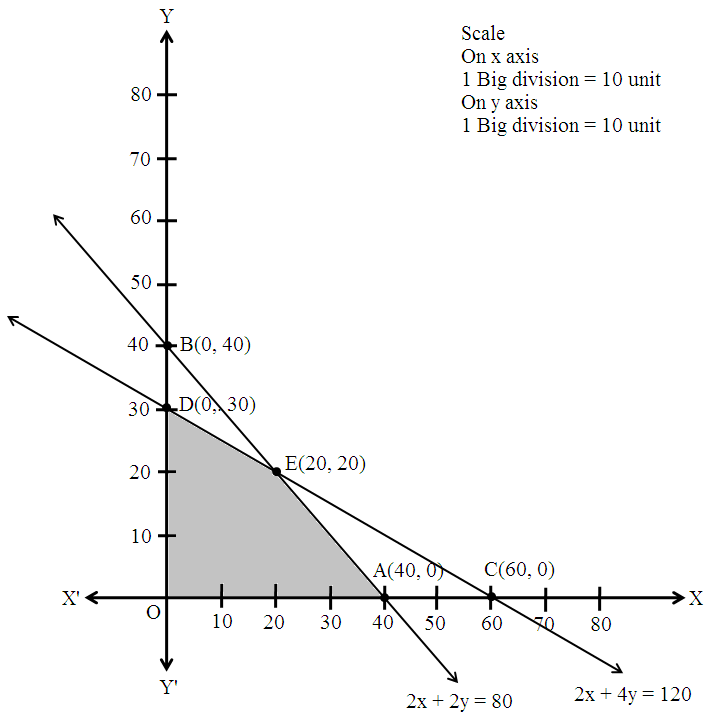
The corner points of the feasible region are O(0, 0), A(40, 0), E(20, 20) and D(0, 30). The values of Z at these corner points are as follows:
Corner point
Z = 3x +4y
O(0, 0)
3 × 0 + 4 × 0 = 0
A(40, 0)
3 × 40 + 4 × 0 = 120
E(20, 20)
3 × 20 + 4 × 20 = 140
D(0, 30)
10 × 0 + 4 × 30 = 120
We see that the maximum value of the objective function Z is 140 which is at E(20, 20) that means at x = 20 and y = 20. Thus, the optimal value of Z is 140.

Need a full question paper?

Generate a complete, print-ready paper with questions like this in minutes — across 16+ boards, with answer keys.

Start Generating Free

Similar questions

If $\vec{\text{a}},\ \vec{\text{b}},\ \vec{\text{c}}$ are non-coplanar vectors, prove that the point having the following position vectors is collinear:$\vec{\text{a}}+\vec{\text{b}}+\vec{\text{c}},\ 4\vec{\text{a}}+3\vec{\text{b}},\ 10\vec{\text{a}}+7\vec{\text{b}}-2\vec{\text{c}}$
Using differentials, find the approximate values of the following:
$\sqrt{0.082}$
A plane passes through the point (1, -2, 5) and is perpendicular to the line joining the origin to the point $2\hat{\text{i}}+\hat{\text{j}}-\hat{\text{k}}.$ Find the vector and cartesian forms of the equation of the plane.
Find the vector equation of the plane which is at a distance of $\frac{6}{\sqrt{29}}$ from the origin and its normal vector from the origin is $2\hat{\text{i}}-3\hat{\text{j}}+4\hat{\text{k}}$ Also, find its cartesian form.
Solve the following initial value problems:
$\text{xe}^{\frac{\text{y}}{\text{x}}}-\text{y + x}\frac{\text{dy}}{\text{dx}}=0,\text{y(e)}=0$
Find which of the function:
$\text{f(x)}=\begin{cases}|\text{x}|\cos\frac{1}{\text{x}},&\text{if x}\neq0\\0,&\text{if x}=0\end{cases}$
at x = 0
Let $A =\{1,2,3\}$ and $R =\left\{( a , b )\}: a , b \in A\right.$ and $\left|a^2-b^2\right| \leq 5$. Write $R$ as set of ordered pairs. Mention whether $R$ is
i. reflexive
ii. symmetric
iii. transitive
Give reason in each case.
$\triangle=\begin{vmatrix}\cos\alpha\cos\beta&\cos\alpha\sin\beta&-\sin\alpha\\-\sin\beta&\cos\beta&0\\\sin\alpha\cos\beta&\sin\alpha\sin\beta&\cos\alpha \end{vmatrix}$
Prove by Mathematical Induction that $(A′)^n = (A^n)′,$ where $\text{n}\in\text{N}$ for any square matrix $A.$
A particle is moving in a straigth line such that its distance at any time t is given by $\text{S}=\frac{\text{t}^{4}}{4}-2\text{t}^{3}+4\text{t}^{2}-7$. Find when its velocity is maximum and acceleration minimum.