Question
Maximum Z = 3x + 4y
Subject to
$2\text{x}+2\text{y}\leq80$
$2\text{x}+4\text{y}\leq120$

Answer

We have to maximize Z = 3x + 4y

First, we will convert the given inequations into equations, we obtain the following equations:

2x + 2y = 80, 2x + 4y = 120

Region represented by 2x + 2y ≤ 80:

The line 2x + 2y = 80 meets the coordinate axes at A(40, 0) and B(0, 40) respectively. By joining these

points we obtain the line 2x + 2y = 80.

Clearly (0, 0) satisfies the inequation 2x + 2y ≤ 80. So,the region containing the origin represents the solution set of the inequation 2x + 2y ≤ 80.

Region represented by 2x + 4y ≤ 120:

The line 2x + 4y = 120 meets the coordinate axes at C(60, 0) and D(0, 30) respectively. By joining these points we obtain the line 2x + 4y ≤ 120.

Clearly (0, 0) satisfies the inequation 2x + 4y ≤ 120. So,the region containing the origin represents the solution set of the inequation 2x + 4y ≤ 120.

The feasible region determined by the system of constraints, 2x + 2y ≤ 80, 2x + 4y ≤ 120 are as follows:
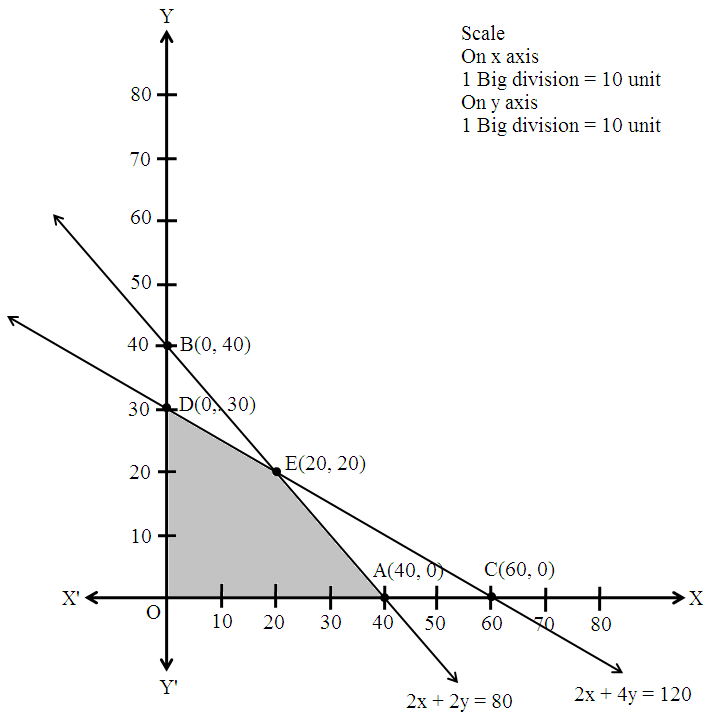
The corner points of the feasible region are O(0, 0), A(40, 0), E(20, 20) and D(0, 30).

The values of Z at these corner points are as follows:

Corner point
Z = 3x +4y
O(0, 0)
3 × 0 + 4 × 0 = 0
A(40, 0)
3 × 40 + 4 × 0 = 120
E(20, 20)
3 × 20 + 4 × 20 = 140
D(0, 30)
10 × 0 + 4 × 30 = 120
We see that the maximum value of the objective function Z is 140 which is at E(20, 20) that means at x = 20 and y = 20.

Thus, the optimal value of Z is 140.

Need a full question paper?

Generate a complete, print-ready paper with questions like this in minutes — across 16+ boards, with answer keys.

Start Generating Free

Similar questions

Solve the following differential equation:
$(\text{x}+\text{y})^2\frac{\text{dy}}{\text{dx}} = 1$
Differentiate the following functions with respect to x:
$\frac{\text{x}^2+2}{\sqrt{\cos\text{x}}}$
Find graphically, the maximum value of $\text{z = 2x + 5y},$ subject to constraints given below:
$2x + 4y \leq 8$
$3x + y \leq 6$
$x + y \leq 4$
$x\geq 0, y\geq 0$
If $\text{A}=\begin{bmatrix}1&0&2\\0&2&1\\2&0&3\end{bmatrix},$ then show that A is a root of the polynomial f(x) = x3 - 6x2 + 7x + 2.
An open box with square base is to be made of a given quantity of card board of area c2. Show that the maximum volume of the box is $\frac{\text{c}^2}{6\sqrt{3}}$ cubic units.
Find the points of local maxima or local minima, if any, of the following functions, using the first derivatives test. Also, find the local maximum or local minimum values, as the case may be: 
$\text{f}(\text{x})=\sin2\text{x},0\leq\text{x}\leq\pi$ 
Using integration, find the area of the region in the first quadrant enclosed by the x-axis, the line y = x and the circle x2 + y2 = 32.
Find the points of discontinuity, if any of the following function:
$\text{f(x)}=\begin{cases}2\text{x},&\text{ if}\text{ x}<0\\0,&\text{if }0\leq\text{x}\leq1\\4\text{x},&\text{if }\text{ x}>1\end{cases}$
Show that the line $\frac{\text{x}+3}{-3}=\frac{\text{y}-1}{1}=\frac{\text{z}-5}{5}$ and $\frac{\text{x}+1}{-1}=\frac{\text{y}-2}{2}=\frac{\text{z}-5}{5}$ are coplanar. Hence, find the equation of the plane containing these lines.
$\begin{vmatrix}\text{b}^2+\text{c}^2&\text{ab}&\text{ac}\\\text{ba}&\text{c}^2+\text{a}^2&\text{bc}\\\text{ca}&\text{cb}&\text{a}^2+\text{b}^2\end{vmatrix}=4\text{a}^2\text{b}^2\text{c}^2$