Question
Maximum $Z = 3x + 5y$
Subject to
$\text{x}+2\text{y}\leq20$
$\text{x}+\text{y}\leq15$
$\text{y}\leq5$
$\text{x},\text{y}\geq0$
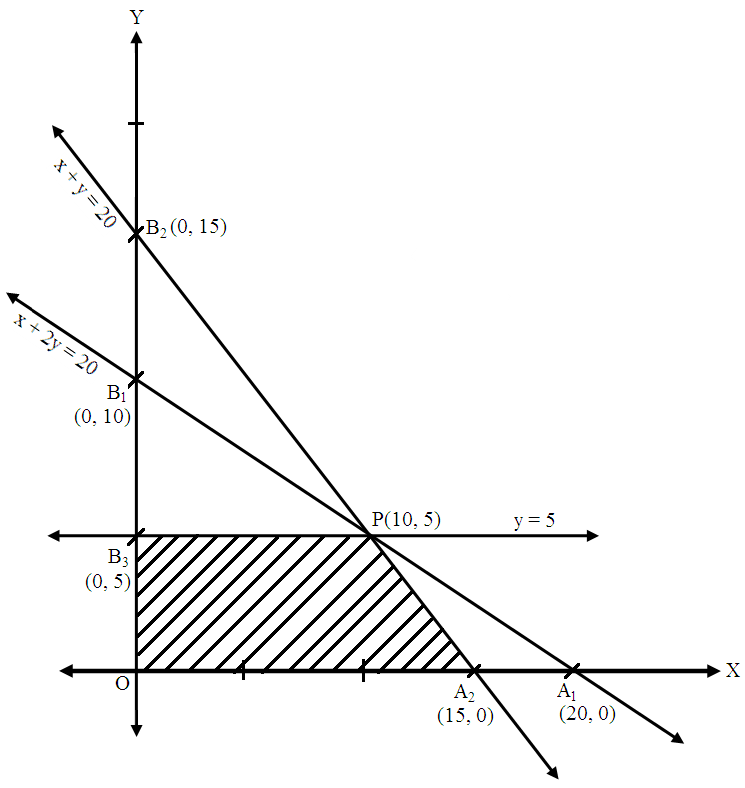
Answer

Converting the given inequations into equation:-

x + 2y = 20, x + y = 15, x = y = 0


Region represented by x + 2y = 20:
Line x + 2y = 20 meets coordinate axes at $A_1(20, 0)$ and $B_1(0, 10)$, clearly, $(0, 0)$ satisfies $\text{x}+2\text{y}\leq20$, so region containing origin represents $\text{x}+2\text{y}\leq20$ in xy -plane.
Region represented by $\text{x}+\text{y}\leq15$:
Line x + y = 15 meets coordinate axes at $A_2(15, 0)$ and $B_2(0, 15)$, clearly, (0, 0) satisfies $\text{x}+\text{y}\leq15$, so region containing origin represents x + y = 15 in xy-plane.
Region represented by $\text{y}\leq5$:
Line y = 5 is parallel to x-axis and meets at $B_3(0, 5)$ on y-axis.
Clearly (0, 0) satisfies $\text{y}\leq5$, so region containing origin represents y s 5 in xy-plane.
Region represented by $\text{x},\text{y}\geq0$:
It represent the first quadrant in xy-plane.
So, shaded region $OA_2PB_3$ represents the feasible region.
Coordinate of P(10, 5) is obtained by solving x + 2y = 20 and y - 5
The value of Z = 3x + 5y at
$O(0, 0) = 3(0) + 5(0) = 0$
$A_2(15, 0) = 3(15) + 5(0) = 45$
$P(10, 5) = 3(10) + 5(5) = 55$
$B_3(0, 5) = 3(0) + 5(5) = 25$
Hence, maximum Z = 55 at x = 10 and y = 5

Need a full question paper?

Generate a complete, print-ready paper with questions like this in minutes — across 16+ boards, with answer keys.

Start Generating Free

Similar questions

Differentiate $\sin^{-1}\Big(2\text{x}\sqrt{1-\text{x}^2}\Big)$ with respect to $\tan^{-1}\Big(\frac{\text{x}}{\sqrt{1-\text{x}^2}}\Big),$ if $-\frac{1}{\sqrt{2}}<\text{x}<\frac{1}{\sqrt{2}}$
If the straight line $\text{x}\cos\alpha+\text{y}\sin\alpha=\text{p}$ touches the curve $\frac{\text{x}^2}{\text{a}^2}-\frac{\text{y}^2}{\text{b}^2}=1,$ then prove that $\text{a}\cos^2\alpha-\text{b}^2\sin^2\alpha=\text{p}^2.$
If $(cos x)^y= (\sin y)^x$, find $\frac{\text{dy}}{\text{dx}}.$
Verify the Rolle’s theorem for each of the functions:
$\text{f(x)}=\sqrt{4-\text{x}^2}\text{ in }[-2,2].$
Show that the following systems of linear equations has infinite number of solutions and solve:
x + y - z = 0,
x - 2y + z = 0,
3x + 6y - 5z = 0
Let R be a relation on the set N of natural numbers defined by nRm if n divides m. Then, R is:
  1. Reflexive and symmetric.
  2. Transitive and symmetric.
  3. Equivalence.
  4. Reflexive, transitive but not symmetric.
Find the angle between the following pairs of lines:$\frac{\text{x}-1}{2}=\frac{\text{y}-2}{3}=\frac{\text{z}-3}{-3}$ and $\frac{\text{x}+3}{-1}=\frac{\text{y}-5}{8}=\frac{\text{z}-1}{4}$
Solve the following differential equation:
$\frac{\text{dy}}{\text{dx}}=\frac{\text{y}}{\text{x}}\{\log\text{y}-\log\text{x}+1\}$
Find the equation of the line passing through the points $\hat{\text{i}}+\hat{\text{j}}-3\hat{\text{k}}$ and perpendicular to the lines $\vec{\text{r}}=\hat{\text{i}}+\lambda\big(2\hat{\text{i}}+\hat{\text{j}}-3\hat{\text{k}}\big)$ and $\vec{\text{r}}=\big(2\hat{\text{i}}+\hat{\text{j}}-\hat{\text{k}}\big)+\mu\big(\hat{\text{i}}+\hat{\text{j}}+\hat{\text{k}}\big).$
Find the area under the curve $\text{y}=\sqrt{6\text{x}+4}$ above x-axis from $x = 0$ to $x = 2$. Draw a sketch of curve also.