Question
Maximum $Z = 3x + 5y$
Subject to
$\text{x}+2\text{y}\leq20$
$\text{x}+\text{y}\leq15$
$\text{y}\leq5$
$\text{x},\text{y}\geq0$
Answer

Converting the given inequations into equation:-
$x + 2y = 20, x + y = 15, x = y = 0$

Region represented by $x + 2y = 20:$
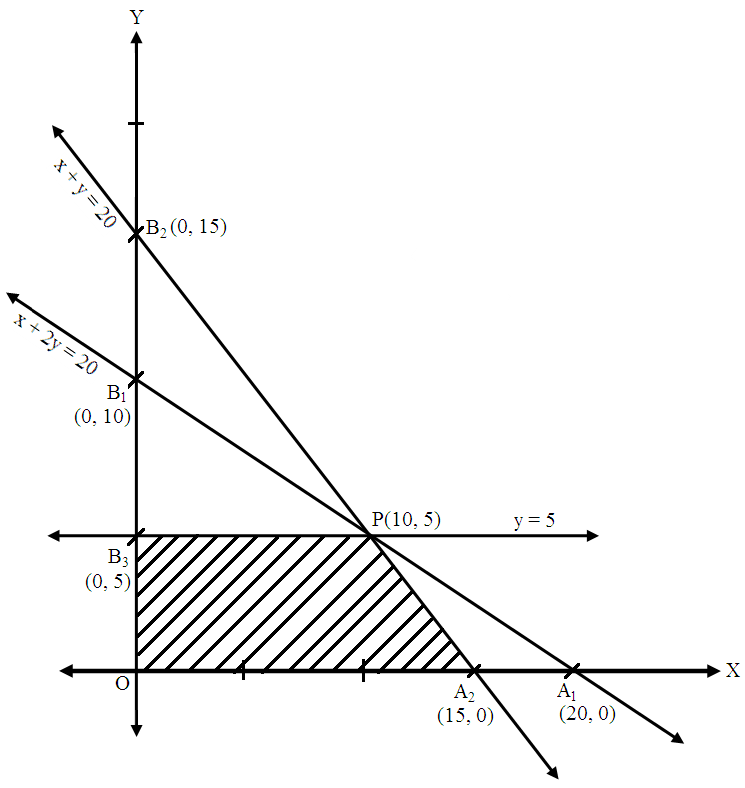
Line x + 2y = 20 meets coordinate axes at $A_1(20, 0)$ and $B_1(0, 10)$, clearly, (0, 0) satisfies $\text{x}+2\text{y}\leq20$, so region containing origin represents $\text{x}+2\text{y}\leq20$ in xy -plane.
Region represented by $\text{x}+\text{y}\leq15$:
Line x + y = 15 meets coordinate axes at $A_2(15, 0)$ and $B_2(0, 15)$, clearly, (0, 0) satisfies $\text{x}+\text{y}\leq15$, so region containing origin represents x + y = 15 in xy-plane.
Region represented by $\text{y}\leq5$:
Line y = 5 is parallel to x-axis and meets at $B_3(0, 5)$ on y-axis.
Clearly (0, 0) satisfies $\text{y}\leq5$, so region containing origin represents y s 5 in xy-plane.
Region represented by $\text{x},\text{y}\geq0$:
It represent the first quadrant in xy-plane.
So, shaded region$ OA_2PB_3$ represents the feasible region.
Coordinate of P(10, 5) is obtained by solving $x + 2y = 20$ and $y - 5$
The value of $Z = 3x + 5y$ at
$O(0, 0) = 3(0) + 5(0) = 0$
$A_2(15, 0) = 3(15) + 5(0) = 45$
$P(10, 5) = 3(10) + 5(5) = 55$
$B_3(0, 5) = 3(0) + 5(5) = 25$
Hence, maximum $Z = 55$ at $x = 10$ and $y = 5$

Need a full question paper?

Generate a complete, print-ready paper with questions like this in minutes — across 16+ boards, with answer keys.

Start Generating Free

Similar questions

Find a 2 × 2 matrix A such that.
$\text{A}\begin{bmatrix}1&-2\\1&4\end{bmatrix}=6\text{I}_2$
Evaluate the following integrals:$\int_{0}^\limits{1}\text{x}\tan^{-1}\text{x}\text{ dx} $
If three numbers are added, their sum is $2$. If $2$ times the second number is subtracted from the sum of first and third numbers, we get $8$ and if three times the first number is added to the sum of second and third numbers, we get $4$. Find the numbers using matrices.
If A and B are two events such that $2\text{P(A)}=\text{P(B)}=\frac{5}{13}$ and $\text{P}\Big(\frac{\text{A}}{\text{B}}\Big)=\frac{2}{5}$ find $\text{P}(\text{A}\cap\text{B}).$
Solve the following differential equation:
$(\text{x}+2\text{y})\text{dx}-(2\text{x}-\text{y})\text{dy}=0$
Without expanding, prove that:
$\begin{vmatrix}\text{a}&\text{b}&\text{c}\\\text{x}&\text{y}&\text{z}\\\text{p}&\text{q}&\text{r}\end{vmatrix}=\begin{vmatrix}\text{x}&\text{y}&\text{z}\\\text{p}&\text{q}&\text{r}\\\text{a}&\text{b}&\text{c}\end{vmatrix}=\begin{vmatrix}\text{y}&\text{b}&\text{q}\\\text{x}&\text{a}&\text{p}\\\text{z}&\text{c}&\text{r}\end{vmatrix}$
A rubber company is engaged in producing three types of tyres A, B and C. Each type requires processing in two plants, Plant I and Plant II. The capacities of the two plants, in number of tyres per day, are as follows:
Plant
A
B
C
I
50
100
100
II
60
60
200
The monthly demand for tyre A, B and C is 2500, 3000 and 7000 respectively. If plant I costs Rs. 2500 per day, and plant II costs Rs. 3500 per day to operate, how many days should each be run per month to minimize cost while meeting the demand? Formulate the problem as LPP.
If a young man drives his vehicle at 25 km/hr, he has to spend Rs. 2 per km on petrol. If he drives it at a faster speed of 40 km/hr, the petrol cost increases to Rs. 5 per km. He has Rs. 100 to spend on petrol and travel within one hour. Express this as an LPP and solve the same.
Evaluate the following integrals:
$\int\frac{1}{(2\text{x}^2+3)\sqrt{\text{x}^2-4}}\text{ dx}$
Solve the following equation for x:
$\tan^{-1}\frac{\text{x}-2}{\text{x}-1}+\tan^{-1}\frac{\text{x}+2}{\text{x}+1}=\frac{\pi}{4}$