Question
Mean solar day is the time interval between two successive noon when sun passes through zenith point (meridian). Sidereal day is the time interval between two successive transit of a distant star through the zenith point (meridian). By drawing appropriate diagram showing earth’s spin and orbital motion, show that mean solar day is four minutes longer than the sidereal day. In other words, distant stars would rise 4 minutes early every successive day.
Answer

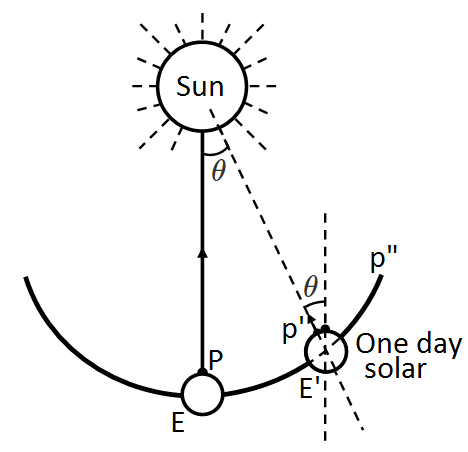
According to the diagram alongside, when the earth revolves about its polar axis in one sidereal day, it also moves from E to E’ around the sun due to translational motion and the point P’ is at P’’.
When the Earth still rotates through an angle about its axis to complete one solar day until the point P’ is at P”, again facing the sun.
Earth advances in its orbit by approximately 1° every day, i.e. in 24 hours. Then, it will have to rotate by 361° (which we define as 1 day) to have the sun at zenith point again,
$\therefore$ Time taken to traverse $1^0=\frac{24\text{h}}{361^0}\times1^0\frac{24\times60\times6\text{s}}{361}=239.3\text{s}$
i.e., 239.3s = 3 min 59.3s ≈ 4 min
Hence, distante stars would rise 4 minutes early every successive day.

Need a full question paper?

Generate a complete, print-ready paper with questions like this in minutes — across 16+ boards, with answer keys.

Start Generating Free

Similar questions

A wire ab of length l, mass m and resistance R slides on a smooth, thick pair of metallic rails joined at the bottom as shown in figure. The plane of the rails makes an angle θ with the horizontal. A vertical magnetic field B exists in the region. If the wire slides on the rails at a constant speed v, show that$\text{B}=\sqrt{\frac{\text{mgR}\sin\theta}{\text{vl}^2\cos^2\theta}}$
Given in are examples of some potential energy functions in one dimension. The total energy of the particle is indicated by a cross on the ordinate axis. In each case, specify the regions, if any, in which the particle cannot be found for the given energy. Also, indicate the minimum total energy the particle must have in each case. Think of simple physical contexts for which these potential energy shapes are relevan.
A metre scale is made up of steel and measures correct length at $16^{\circ} \mathrm{C}$. What will be the percentage error if this scale is used:
a. On a summer day when the temperature is $46^{\circ} \mathrm{C}$.
b. On a winter day when the temperature is $6^{\circ} \mathrm{C}$ ? Coefficient of linear expansion of steel $=11 \times 10^{-60} \mathrm{C}^{-1}$.
Explain why. There is no atmosphere on moon.
The resistance of an iron wire and a copper wire at 20°C are $3.9\Omega$ and $4.1\Omega,$ respectively. At what temperature will the resistance be equal? Temperature coefficient of resistivity for iron is $5.0\times10^{-3}\text{K}^{-1}$ and for copper, it is $4.0\times10^{-3}\text{K}^{-1}.$ Neglect any thermal expansion.
From a certain apparatus, the diffusion rate of hydrogen has an average value of $28.7 \mathrm{~cm}^3 \mathrm{~s}^{-1}$. The diffusion of another gas under the same conditions is measured to have an average rate of $7.2 \mathrm{~cm}^3 \mathrm{~s}^{-1}$. Identify the gas. [Hint: Use Graham's law of diffusion $\frac{\mathrm{R}_1}{\mathrm{R}_2}=\left(\frac{\mathrm{M}_2}{\mathrm{M}_1}\right)^{\frac{1}{2}}$, where $\mathrm{R}_1, \mathrm{R}_2$ are diffusion rates of gases 1 and 2 , and $\mathrm{M}_1$ and $\mathrm{M}_2$ their respective molecular masses. The law is a simple consequence of kinetic theory]
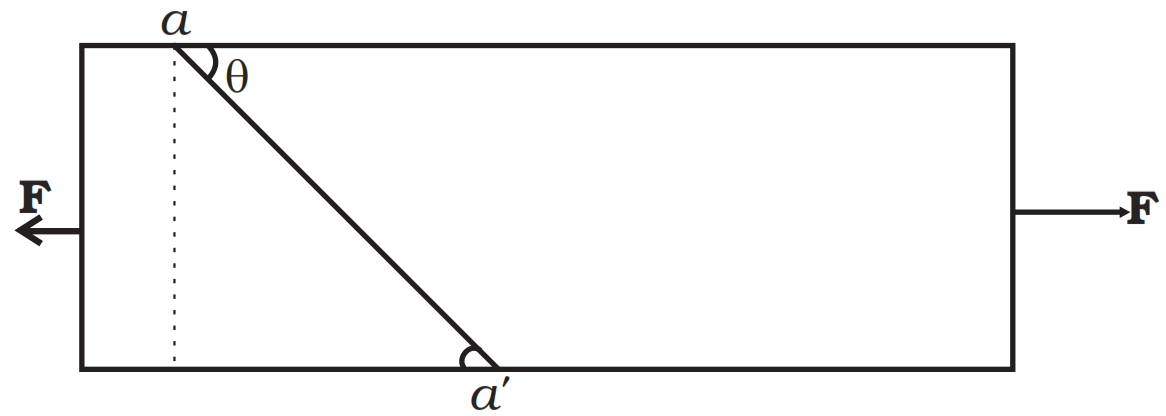
Consider a long steel bar under a tensile stress due to forces F acting at the edges along the length of the bar. Consider a plane making an angle $\Delta$ with the length. What are the tensile and shearing stresses on this plane?
  1. For what angle is the tensile stress a maximum?
  2. For what angle is the shearing stress a maximum?
A tuning fork vibrating with a frequency of 512Hz is kept close to the open end of a tube filled with water The water level in the tube is gradually lowered. When the water level is 17cm below the open end, maximum intensity of sound is heard. If the room temperature is 20° C, calculate
  1. Speed of sound in air at room temperature
  2. Speed of sound in air at 0° C
  3. If the water in the tube is replaced with mercury, will there be any difference in your observations?
On an open ground, a motorist follows a track that turns to his left by an angle of $60^{\circ}$ after every 500 m . Starting from a given turn, specify the displacement of the motorist at the third, sixth and eighth turn. Compare the magnitude of the displacement with the total path length covered by the motorist in each case.
A body cools from 80 °C to 50 °C in 5 minutes. Calculate the time it takes to cool from 60°C to 30 °C. The temprature of the surroundings is 20°C.