Question
Mendeleev predicted the existence of certain elements not known at that time and named two of them as eka - aluminium, and eka - silicon.
  1. Name the element which has taken the place of $(i)$ eka - aluminium, and $(ii)$ eka - silicon.
  2. Mention the period/ periods of these elements in the modern periodic table.
  3. Write the group/ groups of these elements in the modern periodic table.
  4. Classify these elements as metals, non - metals or metalloids.
  5. How many valence electrons are present in the atoms of each of these elements$?​​​​​​$

Answer

  1.  
  1. Gallium.
  2. Germanium.
  1. $4^{th} $  period.
  2. Gallium: $13^{th} $ group; Germanium: $14^{th} $ group.
  3. Gallium: Metal; Germanium: Metalloid.
  4. Gallium: $3;$ Germanium$: 4.$

Need a full question paper?

Generate a complete, print-ready paper with questions like this in minutes — across 16+ boards, with answer keys.

Start Generating Free

Similar questions

Write short notes: Homologous series.
What is meant by an artificial satellite? How are the satellites classified based on their functions?
(OR)
Write the importance of artificial satellites in your words. (Practice Activity Sheet – 3)
Distinguish between the physical properties of metals and nonmetals with respect to the following points:
(1) Physical state (2) Lustre (3) Ductility and malleability (4) Conduction of heat and electricity (5) Hardness (6) Melting and boiling points.
Write short notes: Catenation power.
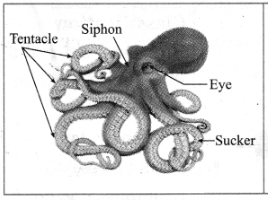
(a) Identify the animal given here.
(b) Write the phylum to which it belongs.
(c) Identify the pointed parts; p, q, r and s.
Image
What is a synapse? What happens at the synapse between two neurons? How are the messages carried across a synapse? Explain with the help of a labelled diagram.
The gravitational pull of the moon cause the sea-water to rise periodically.
  1. What name is given to the condition of the sea when water to rise periodically.
  2. What name is given to the condition of the sea when its raised water recedes?
  3. What name is given to the energy which can be harnessed from this natural phenomenon?
  4. Draw labelled diagram to show how this energy can be harnessed from this natural.
You are given three resistances of 1,2 and 3 ohms. Show by diagrams, how with the help of these resistances you can get:
  1. $6\Omega$
  2. $\frac{6}{11}\Omega$
  3. $1.5\Omega$
Write short notes: Position of isotopes in the Mendeleev’s and the modern periodic table.
An electric bulb of resistance $20 Ω$ and a resistance wire of $4 Ω $are connected in series with a 6V battery. Draw the circuit diagram and calculate:
  1. Total resistance of the circuit.
  2. Current through the circuit.
  3. Potential difference across the electric bulb.
  4. Potential difference across the resistance wire.