Question
Mention Kepler's law.

Answer

Kepler's law :
(i) Every planet revolves around the sun in an elliptical orbit and the sun is at one focus of the orbit.
(ii) The line joining any planet to the sun coasses the same area in equal time intervals i.e., regional velocity of the planet $\left(\frac{d A}{d t}\right)$ remains fixed.
(iii) The square of the period of revolution of a planet is proportional to the third power of the average distance of the planet from the sun. That is,
$\begin{aligned}
T^2 & \propto r^3 \\
T & \propto r^{3 / 2}
\end{aligned}$
$T=K r^{3 / 2} \text { where } K \text { is constant. }$
The law of areas can be considered as a conclusion of angular momentum conservation which is valid for all central forces. The central force acting on a planet acts along the vector joining the central sun and the planet.

Need a full question paper?

Generate a complete, print-ready paper with questions like this in minutes — across 16+ boards, with answer keys.
Start Generating Free

Similar questions

A car is moving on road with speed 54kmh. What should be the value of torque if the car is brought to rest in 15 seconds? Radius and moment of inertia of wheel about the axis of rotation are 0.35m and 3kgm respectively.
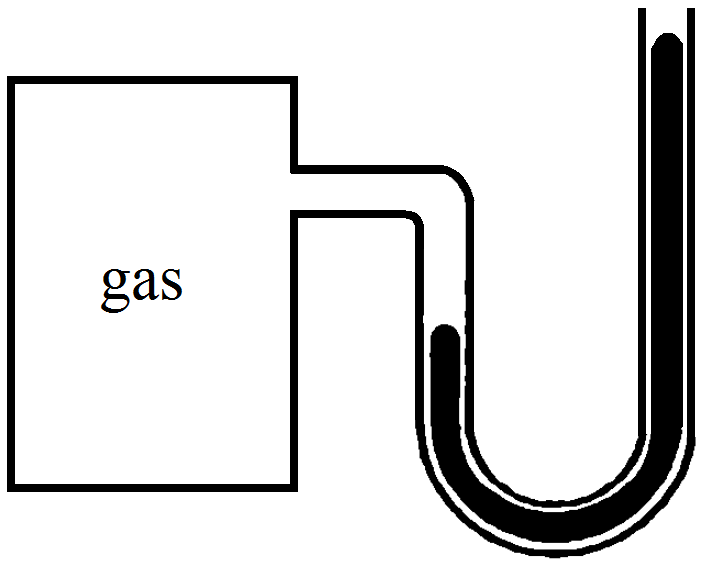
The heights of mercury surfaces in the two arms of the manometer shown in figure are 2cm and 8cm. Atmospheric pressure = 1. 01 x 105N/rn2. Find.

  1. Thepressure of the gas in the cylinder and.
  2. The pressure of mercury at the bottom of the U tube.

In an artery of radius 'a' blood flows with a uniform speed v. If radius of artery becomes $'\frac34\text{a}'$ due to the accumulation of plague on its inner walls, what will be the flow of the blood through the constriction?
Explain temperature on the basis of molecular kinetic theory.
The friction force of air on an object moving in air is directly proportional to the velocity of the object, what will be the dimension of constant of proportionality (b)?
A sphere starts rolling down an incline of inclination $\theta.$ Find the speed of its centre when it has covered a distance l.
Three process $A, B, C$ of expansion of a gas from initial volume $V_1$ to final volume $V_2$ are shown in the figure tell which of these change is isothermal, isobaric and adiabatic?
A block of mass $m=1 kg$, moving on a horizontal surface with speed $V_l=2 m s ^{-1}$ enters a rough patch ranging from $x=0.10 m$ to $x=2.01 m$. The retarding force $F_r$ on the block in this range is inversely proportional to $x$ over this range,
$ F_r=\frac{-k}{x} \text { for } 0.1<x<2.01 m $ $=0$ for $x<0.1 m$ and $x>2.01 m$
where $k=0.5 J$. What is the final kinetic energy and speed $v_f$ of the block as it crosses this patch?
Suppose you have two forces $\vec{\text{F}}$ and $\vec{\text{F}}.$ How would you combine them in order to have resultant force of magnitudes (a) zero, (b) $2\vec{\text{F}}$ and (c) $\vec{\text{F}}?$
Air gets thinner as we go up in the atmosphere. Will the velocity of sound change?