Question
Mention three applications and future challenges of human genome project.

Answer

Salient Features of Human Genome:
  1. There are 3164.7 million nucleotide bases in the human genome.
  2. In an average gene, there are 3000 bases. The largest known human gene is Dystrophin (2.4 million bases).
  3. Total number of genes in human genome are estimated at 30,000. Almost, all (99.9%) of the nucleotide bases are exactly same in every human individual.
Applications and Future Challenges
  1. Its knowledge is helpful in research involving biological systems including human biology.
  2. With the whole genome sequences and newer technologies, we can be systematic in our approach to various medical questions on a broader scale.
  3. All the genes in a genome, e.g. all the transcripts in a particular tissue/ organ/ tumour can be studied.

Need a full question paper?

Generate a complete, print-ready paper with questions like this in minutes — across 16+ boards, with answer keys.
Start Generating Free

Similar questions

Ganga has recently been declared the national river. Discuss the implication with respect to pollution of this river.
Describe the experiment carried out by Hershey and Chase. Write the conclusion they arrived at.
What is vaccination? Explain in detail mother and child vaccination.
What is ecological pyramid? Write its types and give a diagrammatic representation of the pyramid of biomass in the ocean.
A flower of brinjal plant following the process of sexual reproduction produces 360 viable seeds.
Answer the following questions giving reasons:
How many microspore mother cells must have undergone reduction division prior to dehiscence of another in the above case?
Compare the characteristic features of insect pollinated and wind pollinated flowers. Explain how the respective features assist in pollination.
Make a list of any three outbreeding devices that flowering plants have developed and explain how they help to encourage cross-pollination.
Describe fertilization in flowering plants.###Describe the development of female gametophyte and double fertilization in angiosperms.

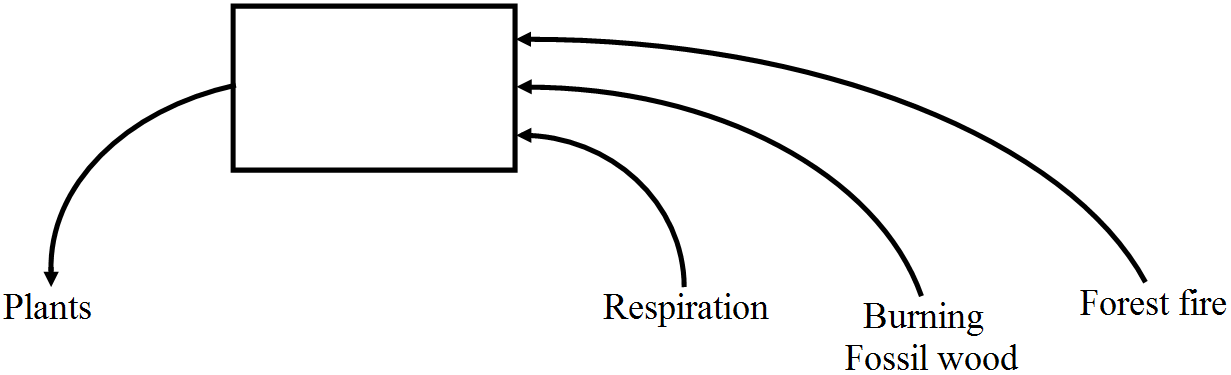
The above diagram shows a simplified biogeochemical cycle.

  1. Name the compound whose cycle is depicted.
  2. In what way do vehicles add this compound to atmosphere?
  3. What adverse effect does its excess have on the environment?
  4. Cite an event which depicts this effect in the modern times.
  5. Suggest two ways of reducing this effect.
Study the following flow chart. Name the hormones involved at each stage. Explain their functions.
Hypothalamus → Pituitary → Testes → Sperms.