Question
Microbes can be used to decrease the use of chemical fertilisers and pesticides. Explain how this can be accomplished.

Answer

Today environmental polloution is a main cause of concern. The use of chemical fertilizers to fill up the increasing demand of agriculture products is the vital cause of this pollution. Biofertilizers are organisms, which increase the nutrient quality of the soil. The main source of biofertilizers are bacteria, fungi and cyanobacteria. We have read about the nodules located on the roots of leguminous plants. These nodules are formed by the symbiotic relationship of Rhizobium. These bacteria fix the atmospheric nitrogen and convert it into organic form. Plants use it as nutrients, other bacteria (eg. Azospirillum and Azotobacter) live freely in the soil can also fix the atmospheric nitrogen. Thus, N2 increases in the soil.
Fungi establish symbiotic relationship with plants. The fungal symbiont in these associations absorbs phosphorus from soil and passes it to the plant. Plants with such relationship exhibit many other benefits like resistance to root-borne pathogens, tolerance to salinity and drought and overall growth and development. Cyanobacteria are autotrophic microbes that are found widely in aquatic and terrestrial environments. Many of these can fix atmospheric nitrogen.
Only the use of biological method to control plant diseases and pests is biological control. In modern society, these problems are controlled with the help of increasing usage of chemicals, insecticides and pesticides. These chemicals are extremely poisonous and harmful for human and animals. They pollute the environment (soil, underground water) and also have harmful effects on fruits, vegetables and crops. Herbicides are used to remove weeds. These also pollute our soil.
The bacteria Bacillus thuringiensis (Bt) is used to control the butterfly catepillers. Baculoviruses are such pathogens that attack insects and arthopods. Nucleopolyhedrovirus (NPU) are considered as best for the treatment of species-specific and narrow-spectrum insecticides.

Need a full question paper?

Generate a complete, print-ready paper with questions like this in minutes — across 16+ boards, with answer keys.

Start Generating Free

Similar questions

a. Draw the embryo sac of a flowering plant and label the following:
i. Central cell
ii. Chalazal end
iii. Synergids
b. Name the cell and explain the process it undergoes to develop into an embryo sac.
c. Explain the development of endosperm in coconut.
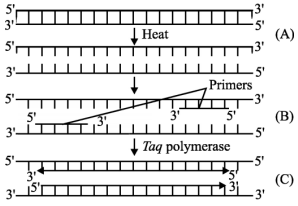
The melding of a technique for repeated rounds of DNA synthesis with the discovery of a thermostable DNA polymerase has given scientists the very powerful technique known as polymerase chain reaction (PCR). PCR is based on three simple steps required for any DNA synthesis reaction: (1) denaturation of the template into single strands; (2) annealing of primers to each original strand for new strand synthesis; and (3) extension of the new DNA strands from the primers.
In the given figure, one cycle of polymerase chain reaction (PCR) is shown:
Image
i. Name the steps A, B and C.
ii. Give the purpose of each of these steps.
iii. State the contribution of Thermus aquaticus in this process.
Describe the components of an ecosystem.
A pregnant woman was adviced to undergo medical termination of pregnancy. Her doctor found that the foetus in her womb was developed from a zygote made of an XX egg fertilized by a Y-bearing sperm? Why was she advised to undergo MTP?
Let us assume in a given plant the genotype symbol “Y” stands for dominant yellow seed colour and “y” for recessive green seed colour; symbol “R” for round seed shape and “r” for wrinkled seeds.
Two homozygous parents (plants) with genotypes “RRYY” and “rryy” are crossed and their F1–generation progeny is then selfed. What shall be the:
  1. Phenotype of F1–progeny.
  2. Genotype of F1–progeny.
  3. Gamete genotypes of F1–progeny.
  4. Phenotypic ratio of F2 population.
  5. Phenotypic ratio of yellow seed to green seed and round seed to wrinkled seed in F2 population.
Explain briefly the ‘rivet popper hypothesis’ of Paul Ehrlich.
What is a test cross? How can it decipher the heterozygosity of a plant?###Explain Mendel's Test cross only by figure.###What is a test cross? Show phenotypic ratio 1 : 1 in a monohybrid test cross through punnet square.###During a monohybrid corss involving a tall pea plant with a dwarf pea plant the offspring populations were tall and dwarf in equal ratio work out a cross to show how it possible.
a. Where is microsporangium located in an angiosperm? State the functions of tapetum and the other three layers of microsporangium.
b. Describe the structure of the male gametophyte produced as a result of microsporogenesis.
c. State the functions of each part of the male gametophyte.
The following is the illustration of the sequence of ovarian events (a – i) in a human female.

Draw a labelled sketch of the structure of a human ovum prior to fertilisation.

Define species-area relationship pattern of biodiversity in detail.