Question
Microorganisms in sewage.

Answer

  1. Sewage contains pathogenic bacteria, viruses, fungi, protozoa which cause dysentery, cholera, typhoid, polio and infectious hepatitis, etc. It also contains nematodes and algae.
  2. Their number and type of microorganisms in sewage depends on the composition and source of sewage.
  3. Millions of bacteria per ml may be present in raw untreated sewage.
  4. Bacteria in sewage include coliforms, fecal Streptococci, anaerobic spore forming bacilli and other bacteria found in the intestinal tract of humans.
  5. The sewage also contains soil bacteria.
  6. During sewage decomposition, initially aerobic and facultative anaerobic organisms predominate which are followed by strict anaerobic especially methogenic bacteria that produce methane $(CH_4)$ and $CO_2.$

Need a full question paper?

Generate a complete, print-ready paper with questions like this in minutes — across 16+ boards, with answer keys.
Start Generating Free

Similar questions

Describe the structure and function of midbrain.
Differentiate between the following:
  1. Polygenic inheritance and Pleiotropy.
  2. Dominance, Codominance and Incomplete dominance.
Long Answer Questions
With the help of neat labelled diagram, describe the structure of chromosome.
Of the four major causes for the loss of biodiversity (Alien species invasion, habitat loss and fragmentation, over-exploitation and co-extinctions which according to you is the major cause for the loss of biodiversity? Give reasons in support.
Sakshi's father announced that the children are going to spend this weekend with their grandparents. During the journey, Sakshi saw some farmers who were spraying agrochemicals in their field. She requested her father to stop them. Her father praised her and contacted the farmers. He explained the side effects of such agrochemicals. He also suggested them to use biopesticides and biofertilisers instead of such chemicals. The farmers gave up spraying agrochemicals.
  1. What did Sakshi's father explain to the farmers?
  2. What are agrochemicals?
  3. Why are biofertilisers or biopesticides preferred to chemical fertilisers or pesticides?
  4. What values did Sakshi promote?
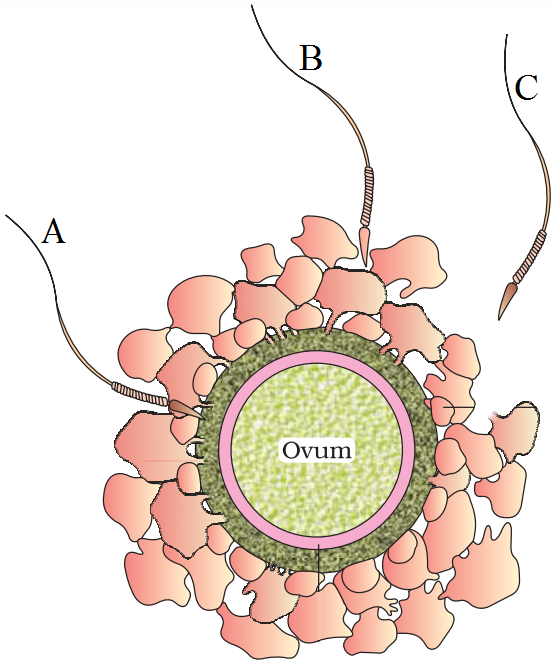
Given below is the diagram of a human ovum surrounded by a few sperms. Observe the diagram and answer the following questions:
Compare the fate of sperms shown in the diagram.
Number of gyri is related to the degree of intelligence.
Homo erectus.
Why do large animals cannot carry out respiration without the help of circulatory system?
Give reasons:
(a) Lymphatic vessels are milky in appearance.
(b) Monocytes are called scavengers.
(c) The wall of left ventricle is thicker than the right ventricle.
(d) Valves are present in the veins.
(e) Pulmonary veins carry oxygenated blood.