MCQ
Modulus of rigidity of ideal liquids is
  • A
    Infinity.
  • B
    Zero.
  • C
    Unity.
  • D
    Some finite small non - zero constant value.

Answer

  1. Zero.

Explanation:

As the liquid is ideal, hence it does not have frictional force among it's layers, thus the tangential forces are zero as there is no stress developed. This verifies.

Need a full question paper?

Generate a complete, print-ready paper with questions like this in minutes — across 16+ boards, with answer keys.
Start Generating Free

Similar questions

A ship is travelling due east at $10\, km/hr$. $A$ ship heading $30^o$ east of north is  always due north from the first ship. The speed of the second ship in $km/hr$ is
The speed of sound in a gas is v. The rms speed of molecules of this gas is C. If $\gamma=\frac{\text{C}_{\text{p}}}{\text{C}_{\text{v}}},$ then the ratio of v and C is:
If the time of flight of a bullet over a horizontal range $R$ is $T\, seconds$, the inclination of the direction of projection to the horizontal is
A black body radiates energy at the rate of $E$ $W/m^2$ at a high temperature $TK$ . When the temperature is reduced to $\frac{T}{2}K$, the radiant energy will be
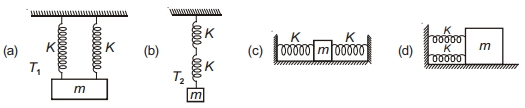
A mass $m$ is attached to two springs of same force constant $K$, as shown in following four arrangements. If $T_1, T_2, T_3$ and $T_4$ respectively be the time periods of oscillation in the following arrangements, in which case time period is maximum?
A tuning fork of frequency $340\,Hz$ resonates in the fundamental mode with an air column of length $125\,cm$ in a cylindrical tube closed at one end. When water is slowly poured in it, the minimum height of water required for observing resonance once again is________ $cm$

(Velocity of sound in air is $340\,ms ^{-1}$ )

A heavy stone is thrown from a cliff of height h with a speed $\nu.$ The stone will hit the ground with maximum speed if it is thrown:
  1. Vertically downward.
  2. Vertically upward.
  3. Horizontally.
  4. The speed does not depend on the initial direction.
How is the temperature of stars determined by
The speed of a transverse wave passing through a string of length $50 \;cm$ and mass $10\,g$ is $60\,ms ^{-1}$. The area of cross-section of the wire is $2.0\,mm ^{2}$ and its Young's modulus is $1.2 \times 10^{11}\,Nm ^{-2}$. The extension of the wire over its natural length due to its tension will be $x \times 10^{-5}\; m$. The value of $x$ is $...$
Moment of inertia of a body about a given axis is $1.5\, kg\, m^2$ Initially the body is at rest. In order to produce a rotational kinetic energy of $1200\, J$, the angular acceleration of $20\, rad/s^2$ must be applied about the axis of rotation for a duration of ......... $\sec$.