MCQ
Molar concentration $(M)$ of any solution $=$
  • $\frac{{{\rm{No}}\,{\rm{. of \,moles\, of\, solute}}}}{{{\rm{Volume\, of \,solution\, in\, litre}}}}$
  • B
    $\frac{{{\rm{No}}{\rm{. \,of \,gram\, equivalent \,of \,solute}}}}{{{\rm{Volume \,of \,solution\, in \,litre}}}}$
  • C
    $\frac{{{\rm{No}}{\rm{. \,of \,moles\, of\, solute}}}}{{{\rm{Mass \,of \,solvent \,in\, kg}}}}$
  • D
    $\frac{{{\rm{No}}{\rm{. \,of\, moles \,of \,any \,constituent}}}}{{{\rm{Total\, no}}{\rm{.\, of \,moles \,of \,all \,constituents}}}}$
Answer

Correct option: A.
$\frac{{{\rm{No}}\,{\rm{. of \,moles\, of\, solute}}}}{{{\rm{Volume\, of \,solution\, in\, litre}}}}$
a
Molarity $(M)$ is defined as the number of moles of solute per liter of solution.

$\text { molarity }=\frac{\text { moles of solute }}{\text { volume of solution in litre. }}$

Need a full question paper?

Generate a complete, print-ready paper with questions like this in minutes — across 16+ boards, with answer keys.

Start Generating Free

Similar questions

For reaction $2A + B \to $ products, the active mass of $ B $ is kept constant and that of $A$ is doubled. The rate of reaction will then
The colour of the $\mathrm{X}_2$ molecules of group $17$ elements changes gradually from yellow to violet down the group. This is due to

[$A$] the physical state of $\mathrm{X}_2$ at atom temperature changes from gas to solid down the group

[$B$] decrease in $HOMO-LUMO$ gap down the group

[$C$] decrease in $\pi^*-\sigma^*$ gap down the group

[$D$] decrease in ionization energy down the group

$PCC$ (Pyridinium chloro chromate) is a good reagent for which of the following  transformations ?
The active materials used in lead-acid battery are:
$Cu(s)|\,C{u^{ + 2}}(aq,{10^{ - 3}})\,|\,|\,A{g^ + }\,({10^{ - 5}}M)|\,Ag(s)$

if $E_{C{u^{ + 2}}/Cu}^o\, = \, + 0.34\,V$

$E_{A{g^ + }/Ag}^o\, = \, + 0.80\,V$

$E_{cell}$ will be

$\begin{matrix}
   \,\,\,\,\,\,\,Br  \\
   \,\,\,\,|  \\
   C{{H}_{3}}-C{{H}_{2}}-C-C{{H}_{2}}-Et  \\
   \,\,\,\,|  \\
   \,\,\,\,\,\,\,\,\,\,\,\,\,\,\,\,\,\,\,\,\,\,\,\,\,\,\,\,\,\,C{{H}_{2}}(n-\Pr )  \\
\end{matrix}\xrightarrow{alc.\,KOH}\underset{(major)}{\mathop{(A)}}\,$

$n - Pr = n -$ propyl
Product' $(A)$ is

Most reactive toward $SN^2$
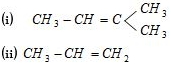
Action of water in the presence of sulphuric acid with the following alkenes gives
$C{H_3}COOC{H_3} + $ excess $PhMgBr$   $ \to {\text{product}}\xrightarrow{{{H^ + }}}X$  The product $X$ is
The compound that will undergo $S_N 1$ reaction with the fastest rate is