MCQ
Molecular shapes of $SF_4 , CF_4$ and $XeF_4$ are
  • A
    the same with $2, 0$ and $1$ lone pair of electrons respectively
  • B
    the same, with $1, 1$ and $1$ lone pair of electrons, respectively
  • C
    different, with $0,1$ and $2$ lone pair of electrons, respectively
  • different with $1,0$ and $2$ lone pair of electrons, respectively

Answer

Correct option: D.
different with $1,0$ and $2$ lone pair of electrons, respectively
d
Molecular shapes of $SF _4$ is square pyramid due to one lone pair of $S$. $CF _4$ has tetrahedral geometry and $XeF _4$ has square planar structure with two lone pair of $Xe.$

Need a full question paper?

Generate a complete, print-ready paper with questions like this in minutes — across 16+ boards, with answer keys.

Start Generating Free

Similar questions

The fragrance of flowers is due to the presence of some steam volatile organic compounds called essential oils. These are generally insoluble in water at room temperature but are miscible with water vapour in vapour phase. $A$ suitable method for the extraction of these oils from the flowers is 
A solution is $500\, ml$ of $2\, M \,KOH$ is added to $500\, ml$ of $2\, M \,HCl$ and the mixture is well shaken.The rise in temperature $T_1$ is noted. The experiment is then repeated using $250\, ml$ of each solution and rise in temperature $T_2$ is again noted. Assume all heat is taken by the solution
Consider the following reversible chemical reactions

${A_2}(g)\, + \,{B_2}(g)\,\overset {{K_1}} \leftrightarrows \,2AB(g)\,\,\,......(1)$

$6AB\,(g)\,\,\overset {{K_2}} \leftrightarrows \,\,3{A_2}(g)\, + \,3{B_2}(g)......(2)$

The relation between $K_1$ and $K_2$ is

The molality of a $10 \%( v / v )$ solution of di-bromine solution in $CCl _4$ (carbon tetrachloride) is $x$. $x=$ $......\times 10^{-2}\,M$. (Nearest integer)

[Given : molar mass of $Br _2=160\,g\,mol ^{-1}$

atomic mass of $C =12\,g\,mol ^{-1}$

atomic mass of $Cl =35.5\,g\,mol ^{-1}$

density of dibromine $=3.2\,g\,cm ^{-3}$

density of $\left.CCl _4=1.6\,g\,cm ^{-3}\right]$

Incorrect statement when $C_2$ change to $C_2^{-2}$
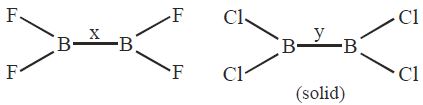
Compare $B—B$ bond length in following molecules :
Outermost electronic configuration of a group $13$ element, $E$, is $4 \,\mathrm{~s}^{2}, 4 p^{1}$. The electronic configuration of an element of $p$-block period-five placed diagonally to element, $E$ is :
Which of the following is polar?
"Hybridisation of central atom does not always change due to back bonding". This  statement is valid for which of the following compounds ?

$(i)\, {CCl_3}^-$       $(ii)\,CCl_2$     $(iii)\, (SiH_3)_2O$     $(iv)\, N(SiH_3)_3$

Which of the following set has the strongest tendency to form anions