MCQ
Molecules in which all fluorine atoms are in same plane is
  • A
    $CHF_3$
  • B
    $ClF_3$
  • C
    $BF_3$
  • All

Answer

Correct option: D.
All
d

Need a full question paper?

Generate a complete, print-ready paper with questions like this in minutes — across 16+ boards, with answer keys.

Start Generating Free

Similar questions

A gaseous compound of nitrogen and hydrogen contains $12.5\%$ (by mass) of hydrogen. The density of the compound relative to hydrogen is $16$ .The molecular formula of the compound is
The number of pentagons in $C_{60} $ and trigons (triangles) in white phosphorus, respectively, are
Which has the maximum number of molecules among the following?
The correct statement regarding the basicity of arylamines is
Arrange the following solutions is the decreasing order of $pOH$

$(A)$ $0.01 \,M\, HCl$

$(B)$ $0.01 \,M \,NaOH$

$(C)$ $0.01 \,M \,CH _{3} COONa$

$(D)$ $0.01 \,M \,NaCl$

In Bohr's atomic model, radius and energy in orbit $(n)$ is related as
What is the name of reaction when benzaldehyde changes into benzyl alcohol
When a metal rod ${M}$ is dipped into an aqueous colourless concentrated solution of compound ${N}$, the solution turns light blue. Addition of aqueous $\mathrm{NaCl}$ to the blue solution gives a white precipitate ${O}$. Addition of aqueous $\mathrm{NH}_3$ dissolves ${O}$ and gives an intense blue solution.

$1.$ The metal rod ${M}$ is

$(A)$ $\mathrm{Fe}$ $(B)$ $\mathrm{Cu}$ $(C)$ $\mathrm{Ni}$ $(D)$ $\mathrm{Co}$

$2.$ The compound ${N}$ is

$(A)$ $\mathrm{AgNO}_3$ $(B)$ $\mathrm{Zn}\left(\mathrm{NO}_3\right)_2$

$(C)$ $\mathrm{Al}\left(\mathrm{NO}_3\right)_3$ $(D)$ $\mathrm{Pb}\left(\mathrm{NO}_3\right)_2$

$3.$ The final solution contains

$(A)$ $\left[\mathrm{Pb}\left(\mathrm{NH}_3\right)_4\right]^{2+}$ and $\left[\mathrm{CoCl}_4\right]^{2-}$

$(B)$ $\left[\mathrm{Al}\left(\mathrm{NH}_3\right)_4\right]^{3+}$ and $\left[\mathrm{Cu}\left(\mathrm{NH}_3\right)_4\right]^{2+}$

$(C)$ $\left[\mathrm{Ag}\left(\mathrm{NH}_3\right)_2\right]^{+}$and $\left[\mathrm{Cu}\left(\mathrm{NH}_3\right)_4\right]^{2+}$

$(D)$ $\left[\mathrm{Ag}\left(\mathrm{NH}_3\right)_2\right]^{+}$and $\left[\mathrm{Ni}\left(\mathrm{NH}_3\right)_6\right]^{2+}$

Give the answer question $1,2$ and $3.$
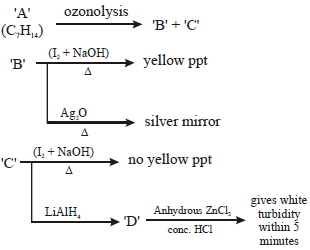
Consider the following reactions $A$ is
The combustion enthalpy of carbon, hydrogen and methane are $-393.5 ;\, -284.8$ and $-890.4\, kJ/mole$ respectively at $25\,^oC$ . The value of standard formation enthalpies of methane at that temperature is.....$kJ/mole$