Question
"Monochromatic light should be used to produce pure spectrum". Comment on this statement.

Answer

No, monochromatic light cannot be used to produce a pure spectrum. A spectrum is produced when a light of different wavelengths is deviated through different angles and gets separated. Monochromatic light, on the other hand, has a single wavelength.

Need a full question paper?

Generate a complete, print-ready paper with questions like this in minutes — across 16+ boards, with answer keys.
Start Generating Free

Similar questions

Each side of a square is 90 cm long. At its corners $-2,+3,-4$ and +5 micro coulomb charges are placed respectively. Find the electric potential at the centre of the square.
During an experiment, an ideal gas is found to obey an additional law $pV^2 =$ constant. The gas is initially at a temperature $T$ and volume $V.$ Find the temperature when it expands to a volume $2V.$
Find the dimensions of:
  1. The specific heat capacity c.
  2. The coefficient of linear expansion a.
  3. The gas constant R.
Some of the equations involving these quantities are$\text{Q = mc(T}_2-\text{T}_1),\text{l}_{\text{t}}=\text{l}_0[1+\alpha(\text{T}_2-\text{T}_1)]$ and $\text{PV = nRT}.$
A brass plate having surface area $200\ cm^2$ on one side is electroplated with $0.10\ mm$ thick silver layers on both sides using a $15A$ current. Find the time taken to do the job. The specific gravity of silver is $10.5$ and its atomic weight is $107.9\ g/mol.$
A voltmeter consists of a $25\Omega$ coil connected in series with a $575\Omega$ resistor. The coil takes 10mA for full scale deflection. What maximum potential difference can be measured by this voltmeter?
Given a uniform electric field $\overrightarrow{\text{E}} = 2 \times 10^3\ \hat{i}\  N/C$ find the flux of this field through a square of side $20 \ cm,$ whose plane is parallel to the $y-z$ plane. What would be the flux through the same square, if the plane makes an angle of $30^{\circ}$ with the$ x-$axis?
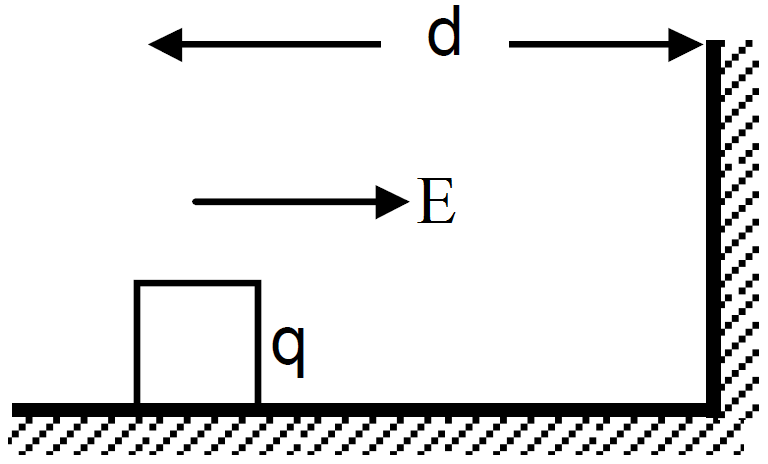
A block of mass m containing a net positive charge q is placed on a smooth horizontal table which terminates in a vertical wall as shown in figure. The distance of the block from the wall is d. A horizontal electric field E towards right is switched on. Assuming elastic collisions (if any) find the time period of the resulting oscillatory motion. Is it a simple harmonic motion?
Two electric bulbs whose resistances are in the ratio 1 : 2 are connected in parallel to a source of constant voltage. What will be the ratio of power dissipation in these wires?
In Young’s double $-$ slit experiment using monochromatic light of wavelength $\lambda, $ the intensities of two sources is $I.$  What is the intensity of light at a point where path difference between wave front is $\lambda / 4$ ?
Suppose $\vec{\text{a}}$ is a vector of magnitude 4.5 unit due north. What is the vector:
  1. $3\vec{\text{a}}$
  2. $-4 \ \vec{\text{a}}?$