Question
"Monochromatic light should be used to produce pure spectrum". Comment on this statement.

Answer

No, monochromatic light cannot be used to produce a pure spectrum. A spectrum is produced when a light of different wavelengths is deviated through different angles and gets separated. Monochromatic light, on the other hand, has a single wavelength.

Need a full question paper?

Generate a complete, print-ready paper with questions like this in minutes — across 16+ boards, with answer keys.
Start Generating Free

Similar questions

Electric potential at a point $P , V (x, y, z)=$ $6 x-8 x y^2-8 y+6 y z-4 z^2$. Find the electric force on a 4 coulomb point charge located at the origin.
The internal resistance of an accumulator battery of emf 6V is $10\Omega$ when it is fully discharged. As the battery gets charged up, its internal resistance decreases to $1\Omega.$
The battery in its completely discharged state is connected to a charger that maintains a constant potential difference of 9V. Find the current through the battery (a) just after the connections are made and (b) after a long time when it is completely charged.
Answer the following question:
As you have learnt in the text, the principle of linear superposition of wave displacement is basic to understanding intensity distributions in diffraction and interference patterns. What is the justification of this principle?
Draw a diagram of magnetic field lines due to any current carrying circular loop.
The short wavelength limit for the Lyman series of the hydrogen spectrum is 913·4 $\mathring{\text{A}}$ Calculate the short wavelength limit for Balmer series of the hydrogen spectrum.
Write down the definition of energy density and derive the equation of energy density of electric field.
A free neutron beta-decays to a proton with a half-life of 14 minutes.
  1. What is the decay constant?
  2. Find the energy liberated in the process.
  1. Can two equipotential surfaces intersect each other? Give reasons.
  2. Two charges – q and +q are located at points A (0, 0, –a) and B (0, 0, +a) respectively. How much work is done in moving a test charge from point P (7, 0, 0) to Q (-3, 0, 0)?
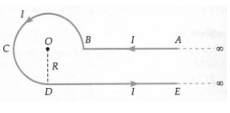
A current I is flowing in an infinitely long conductor bent into the shape shown in Fig. If the radius of the curved part is R, find the magnetic field at the centre O. 
Image
An uncharged capacitor is connected to a battery. Show that half of the energy used by the battery to charge the capacitor is dissipated as heat.