MCQ
Moseley's Law for characteristic $X-$ray is $\sqrt{\text{v}}=\text{a}(\text{z}-\text{b})$. Here,
  • Both $a$ and $b$ are independent of the material.
  • B
    $a$ is independent but $b$ depends on the material.
  • C
    $b$ is independent but a depends on the material.
  • D
    Both $a$ and $b$ depend on the material.
Answer

Correct option: A.
Both $a$ and $b$ are independent of the material.
Moseley's Law for characteristic $X-$ray is $\sqrt{\text{v}}=\text{a}(\text{z}-\text{b})$where, a and b are constants independent of the material used.

Need a full question paper?

Generate a complete, print-ready paper with questions like this in minutes — across 16+ boards, with answer keys.

Start Generating Free

Similar questions

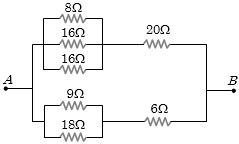
The equivalent resistance of the arrangement of resistances shown in adjoining figure between the points $A$ and $B$ is ............... $ohm$ 
Assertion : In Young’s double slit experiment if wavelength of incident monochromatic light is just doubled, number of bright fringe on the screen will increase.

Reason : Maximum number of bright fringe on the screen is directly proportional to the wavelength of light used.

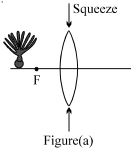
$A$ turnip sits before a thin converging lens, outside the focal point of the lens. The lens is filled with a transparent gel so that it is flexible; by squeezing its ends toward its center [as indicated in figure $(a)$], you can change the curvature of its front and rear sides. The lateral height of image.
When neutrons are bombarded on nucleus of $_{92}{U^{235}}$, the number of emitted neutrons will be
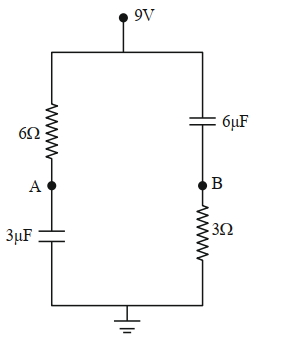
In the given figure, the charge stored in $6 \ \mu \mathrm{F}$ capacitor, when points $A$ and $B$ are joined by a connecting wire is___________ $\mu \mathrm{C}$.
The relation between $I_p$ and $V_p$ for a triode is ${I_p} = (0.125{V_p} - 7.5)\,mA$ Keeping the grid potential constant at  $1V, $ the value of $r_p$  will be.....$k\Omega$
Two lenses are placed in contact with each other and the focal length of combination is 80 cm. If the focal length of one is 20 cm, then the power of the other will be
Equivalent resistance between the adjacent corners of a regular $n$-sided polygon of uniform wire of resistance $R$ would be:
A nuclei having same number of neutron but different number of protons/ atomic number are called:
Two parallel wires carry currents of $20A$ and $40A$ in opposite directions. Another wire carying a current anti parallel to $20A$ is placed midway between the two wires. $T$ he magnetic force on it will be: