MCQ
Motion of a moving electron is not affected by
  • A
    An electric field applied in the direction of motion
  • Magnetic field applied in the direction of motion
  • C
    Electric field applied perpendicular to the direction of motion
  • D
    Magnetic field applied perpendicular to the direction of motion
Answer

Correct option: B.
Magnetic field applied in the direction of motion
b
(b) When field is parallel to the direction of motion of charge, magnetic force on it is zero.

Need a full question paper?

Generate a complete, print-ready paper with questions like this in minutes — across 16+ boards, with answer keys.

Start Generating Free

Similar questions

An $\alpha$- particle of $5\ MeV$ energy strikes with a nucleus of uranium at stationary at an scattering angle of $180^o$. The nearest distance upto which $\alpha$- particle reaches the nucleus will be of the order of
Nichrome or Manganin is widely used in wire bound standard resistors because of their:
In Bainbridge mass spectrograph a potential difference of 1000 V is applied between two plates distant 1 cm apart and magnetic field in B = 1T. The velocity of undeflected positive ions in m/s from the velocity selector is
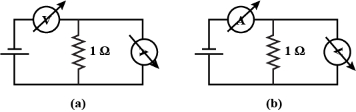
A student uses the resistance of a known resistor $(1 \,\Omega)$ to calibrate a voltmeter and an ammeter using the circuits shown below. The student measures the ratio of the voltage to current to be $1 \times 10^3 \,\Omega$ in circuit $(a)$ and $0.999 \,\Omega$ in circuit $(b)$. From these measurements, the resistance (in $\Omega$ ) of the voltmeter and ammeter are found to be close to
99% of a radioactive element will decay between
An electric dipole of moment $\vec P$ is placed in a uniform electric field $\vec E$ such that $\vec P$ points along $\vec E$ . If the dipole is slightly rotated about an axis perpendicular to the plane containing $\vec E$ and $\vec P$ and passing through the centre of the dipole, the dipole executes simple harmonic motion. Consider $I$ to be the moment of inertia of the dipole about the axis of rotation. What is the time period of such oscillation?
For the production of $X-$ rays of wavelength $0.1 Å$ the minimum potential difference will be.....$kV$
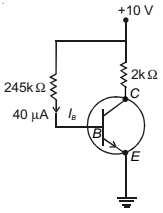
In the following transistor amplifier circuit $\beta=50 . V_{C E}$ of the transistor is .......... $V$
An oscillator circuit consists of an inductance of $0.5\, mH$ and a capacitor of $20\, \mu F$. The resonant frequency of the circuit is nearly (in $Hz$)
Find the true statement.