MCQ
Myopia is due to
  • Elongation of eye ball
  • B
    Irregular change in focal length
  • C
    Shortening of eye ball
  • D
    Older age

Answer

Correct option: A.
Elongation of eye ball
a
(a) In myopia, eye ball may be elongated so, light rays focussed before the retina.

Need a full question paper?

Generate a complete, print-ready paper with questions like this in minutes — across 16+ boards, with answer keys.

Start Generating Free

Similar questions

The ratio of intensities of consecutive maxima in the diffraction pattern due to a single slit is
An application of Bernoulli's equation for fluid flow is found in
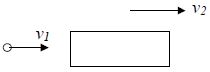
A light particle moving horizontally with a speed $v_1$ strikes a very heavy block moving in the same direction with a speed $v_2$. The collision is elastic. After the collision, the velocity of particle is :-
The first diffraction minimum due to the single slit diffraction is seen at $\theta  = {30^o}$ for a light of wavelength $5000\,\mathop A\limits^o $ falling perpendicularly on the slit. The width of the slit is
If $L , C$ and $R$ are the self inductance, capacitance and resistance respectively, which of the following does not have the dimension of time?
Rain is falling vertically with a speed of $30\,ms^{-1}$ . A woman rides a bicycle with a speed of $12\,ms^{-1}$ in east to west direction. She should hold her umbrella
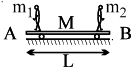
Two persons of mass $m_1$ and $m_2$ are standing at the two ends $A$ and $B $ respectively, of $a$ trolley of mass $M$ as shown. When both the persons jump simultaneously with urel with respect to the trolley, then the velocity of the trolley is
A solid sphere of mass $M,$ radius $R$ and having moment of inertia about an axis passing through the centre of mass as $I$, is recast into a disc of thickness $t$, whose moment of inertia about an axis passing through its edge and perpendicular to its plane remains $I$. Then, radius of the disc will be
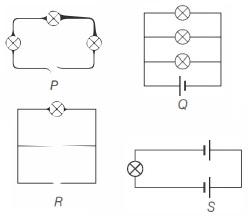
Following figures show different combinations of identical bulb$(s)$ connected to identical battery$(ies)$. Which option is correct regarding the total power dissipated in the circuit?
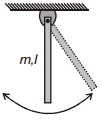
A uniform rod of mass $m$ and length $I$ is suspended about its end, Time period of small angular oscillations is ..........