MCQ
Myopia occurs due to :
  • A
    Increase in the focal length of eye lens
  • B
    Decrease in the distance between retina and lens
  • Decrease in the focal length of the eye lens
  • D
    Increase in the distance between retina and lens

Answer

Correct option: C.
Decrease in the focal length of the eye lens
Myopia is the term used to define short sightedness.
Light from a distant object forms an image before it reaches the retina.
This is because the eye ball is too large, or the cornea or crystalline lens is too strong.
This results in decrease in focal length of eye lens, whereas the distance between retina and lens is always constant.

Need a full question paper?

Generate a complete, print-ready paper with questions like this in minutes — across 16+ boards, with answer keys.
Start Generating Free

Similar questions

Solid calcium oxide reacts vigorously with water to form calcium hydroxide accompanied by liberation of heat. This process is called slaking of lime. Calcium hydroxide dissolves in water to form its solution called lime water. Which among the following is $($are$)$ true about slaking of lime and the solution formed?
  1. It is an endothermic reaction.
  2. It is an exothermic reaction.
  3. The $\ce{pH}$ of the resulting solution will be more than seven.
  4. The $\ce{pH}$ of the resulting solution will be less than seven.
The fuel having a calorific value of 55 kJ/g is likely to be:
Why is the fuse wire fitted in a porcelain casing?
The ability of a cell to divide into several cells during reproduction in Plasmodium is called :
An ecosystem is a complex interacting system of :
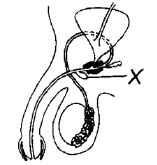
The diagram shows a section through the male reproductive system. What is the function of part X?
Image

i. The secretion of the gland neutralises acids from urine.
ii. It decreases the number of sperms damaged during ejaculation.
iii. It stimulates uterine contraction to help sperms move forward into the fallopian tube.
iv. Both (i) and (ii)
An electrolytic cell consists of :
  1. positively charged cathode
  2. negatively charged anode
  3. positively charged anode
  4. negatively charged cathode
The loss of energy as one proceeds from one trophic level to the next higher level is approximately :
One of the following organic compounds cannot decolourise the red-brown colour bromine water. This compound is:
In the following groups of materials, which group $(s)$ contains only non $-$ biodegradable items?
  1. Wood, paper, leather.
  2. Polythene, detergent $,\text{PVC}.$
  3. Plastic, detergent, grass.
  4. Plastic, bakelite $,\text{DDT}.$