MCQ
$n$ identical bulbs, each designed to draw a power $p$ from a certain voltage supply, are joined in series across that supply. The total power which they will draw is
- A$p/{n^2}$
- ✓$p/n$
- C$p$
- D$np$
Power of each bulb is $P=V^{2} / R$ or $R=V^{2} / P$
As $n$ bulbs are in series so total resistance $R_{t}=n R$ and current $i=V / R_{t}=V / n R$
Total power drawn is $P_{t}=i^{2} R_{t}=\frac{V^{2}}{n^{2} R^{2}}(n R)=\frac{V^{2}}{n R}=P / n$
Generate a complete, print-ready paper with questions like this in minutes — across 16+ boards, with answer keys.
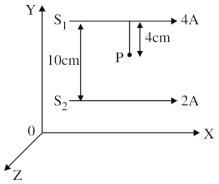
A charge particle of $3 \pi$ coulomb is passing through the point $P$ with velocity
$\overrightarrow{ v }=(2 \hat{ i }+3 \hat{ j }) \,m / s$; where $\hat{i}$ and $\hat{j} \quad$ represents unit vector along $x$ and $y$ axis respectively.
The force acting on the charge particle is $4 \pi \times 10^{-5}(-x \hat{i}+2 \hat{j}) \,N$. The value of $x$ is