MCQ
$n$ identical bulbs, each designed to draw a power $p$ from a certain voltage supply, are joined in series across that supply. The total power which they will draw is
  • A
    $p / n^2$
  • $p / n$
  • C
    $p$
  • D
    $n p$

Answer

Correct option: B.
$p / n$
(b)

Need a full question paper?

Generate a complete, print-ready paper with questions like this in minutes — across 16+ boards, with answer keys.
Start Generating Free

Similar questions

If $\gamma=2.5$ and volume is equal to $\frac{1}{8}$ times to the initial volume then pressure $P^{\prime}$ is equal to (Initial pressure $=P$ )
Which of the following cylindrical rods will conduct most heat, when their ends are maintained at the same steady temperature
If a steady current of $4 amp$ maintained for 40 minutes, deposits 4.5 $g m$ of zinc at the cathode and then the electro chemical equivalent will be
Which one of the following spherical lenses does not exhibit dispersion? The radii of curvature of the surfaces of the lenses are as given in the diagrams
 The resistance of a galvanometer is $50\,\Omega $ and it requires $2\,\mu A$ per two division deflection. The value of the shunt required in order to convert this galvanometer into ammeter of range $5\,A$ is (The number of divisions on the galvanometer scale on one side is $30$)
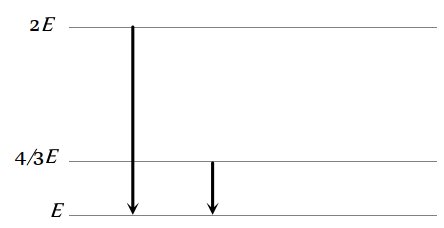
The following diagram indicates the energy levels of a certain atom when the system moves from $2 E$ level to $E$, a photon of wavelength $\lambda$ is emitted. The wavelength of photon produced during its transition from $\frac{4 E}{3}$ level to $E$ isImage
An ideal gas has volume $V_0$ at $27^{\circ} \mathrm{C}$. It is heated at constant pressure so that its volume becomes $2 V_0$. The final temperature is
The similarity between the sound waves and light waves is
The armature of dc motor has $20 \Omega$ resistance. It draws current of $1.5$ ampere when run by $220$ volts dc supply. The value of back e.m.f. induced in it will be
Three rods of identical area of cross-section and made from the same metal form the sides of an isosceles triangle $A B C$, right angled at $B$. The points $A$ and $B$ are maintained at temperatures $T$ and $\sqrt{2} T$ respectively. In the steady state the temperature of the point $C$ is $T_C$. Assuming that only heat conduction takes place, $\frac{T_C}{T}$ is equal to