MCQ
$\mathrm{N}_2+3 \mathrm{H}_2 \rightleftharpoons 2 \mathrm{NH}_3$

Which is correct statement if $\mathrm{N}_2$ is added at equilibrium condition?

  • A
    The equilibrium will shift to forward direction because according to $\mathrm{II}^{\text {nd }}$ law of thermodynamics the entropy must increases in the direction of spontaneous reaction.
  • The condition for equilibrium is $\mathrm{G}_{\mathrm{N}_2}+3 \mathrm{G}_{\mathrm{H}_2}=2 \mathrm{G}_{\mathrm{NH}_3}$ where $\mathrm{G}$ is Gibbs free energy per mole of the gaseous species measured at that partial pressure. The condition of equilibrium is unaffected by the use of catalyst, which increases the rate of both the forward and backward reactions to the same extent.
  • C
    The catalyst will increase the rate of forward reaction by $\alpha$ and that of backward reaction by $\beta$.
  • D
    Catalyst will not alter the rate of either of the reaction.
Answer

Correct option: B.
The condition for equilibrium is $\mathrm{G}_{\mathrm{N}_2}+3 \mathrm{G}_{\mathrm{H}_2}=2 \mathrm{G}_{\mathrm{NH}_3}$ where $\mathrm{G}$ is Gibbs free energy per mole of the gaseous species measured at that partial pressure. The condition of equilibrium is unaffected by the use of catalyst, which increases the rate of both the forward and backward reactions to the same extent.
b

Need a full question paper?

Generate a complete, print-ready paper with questions like this in minutes — across 16+ boards, with answer keys.

Start Generating Free

Similar questions

$C_6H_6+\,C{{H}_{3}}C{{H}_{2}}C{{H}_{2}}Cl\,+\,AlC{{l}_{3}}\,\to $ $X$ (Major product)

$X$ (Major product) $\xrightarrow{HN{{O}_{3}}+{{H}_{2}}S{{O}_{4}}}Y$ (Major product)  $\xrightarrow{Sn\,\,+\,\,HCl}\,Z\,\xrightarrow[S{{O}_{3}}]{}W$

$W$ is 

When ${10^{ - 8}}$ mole of $HCl$ is dissolved in one litre of water, the $pH$ of the solution will be
${H_3}P{O_2}$ is the formula for one of the phosphorus acid. Its name and basicity are respectively
The orbital angular momentum of a $p-$ electron is given as
For $n = 3$ energy level, the number of possible orbitals (all kinds) are
Molality (m) of $3 \mathrm{M}$ aqueous solution of $\mathrm{NaCl}$ is:

(Given : Density of solution $=1.25 \mathrm{~g} \mathrm{~mL}^{-1}$, Molar mass in $\left.\mathrm{g} \mathrm{mol}^{-1}: \mathrm{Na}-23, \mathrm{Cl}-35.5\right)$

One and a half mole of oxygen combine with aluminium to form $Al_2O_3$ , then the weight of aluminium metal used in this reaction is ............. $\mathrm{gms}$ (Atomic weight of  $Al = 27$ )
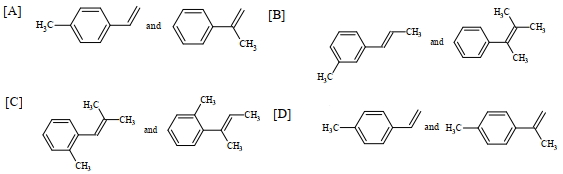
Compounds $P$ and $R$ upon ozonolysis produce $Q$ and $S$, respectively. The molecular formula of $Q$ and $S$ is $C_8 \mathrm{H}_8 \mathrm{O}$. $Q$ undergoes Cannizzaro reaction but not haloform reaction, whereas $\mathrm{S}$ undergoes haloform reaction but not Cannizzaro reaction.

($i$) $P \xrightarrow[\text { ii) } \mathrm{Zn} / \mathrm{H}_2 \mathrm{O}]{\text { i) } \mathrm{O}_3 / \mathrm{CH}_2 \mathrm{Cl}_2} \underset{\left(\mathrm{C}_8 \mathrm{H}_8 \mathrm{O}\right)}{Q}$

($ii$) $R \xrightarrow[\text { ii) } \mathrm{Zn} / \mathrm{H}_2 \mathrm{O}]{\text { i) } \mathrm{O}_3 / \mathrm{CH}_2 \mathrm{Cl}_2} \underset{\left(\mathrm{C}_8 \mathrm{H}_8 \mathrm{O}\right)}{S}$

The option(s) with suitable combination of $P$ and $R$, respectively, is(are)

In which of the following process energy is absorbed ?
Among the following vitamins the one whose deficiency causes rickets (bone deficiency) is