Question
NAM was considered a ‘third option’ by Third World countries. How did this option benefit their growth during the peak of the Cold War?

Answer

  1. The ‘third option’ i.e., not to join either alliance benefitted the growth of Third World countries during the peak of the Cold War. Most of the non-aligned countries were the Least Developed Countries (LDCs). The challenge before them was to be more developed economically and to lift their people out of poverty. Economic development was vital for the independence of these countries. By not joining the either bloc, they got help from both the camps.
  2. The idea of a New International Economics Order too originated during this period. The United Nation's Conference on Trade and Development (UNCTAD) in its report - Towards a New Trade Policy for Development - proposed a reform of the global trading system which provided LDCs a greater role in international economic institutions and control over their natural resources.
  3. Gradually the nature of non-alignment changed to give greater importance to economic issues and it became a economic pressure group. Thus, third option — not to join either alliance — benefitted their growth during the peak of the Cold War.

Need a full question paper?

Generate a complete, print-ready paper with questions like this in minutes — across 16+ boards, with answer keys.
Start Generating Free

Similar questions

No region exists in a vacuum. It is influenced by outside powers and events, no matter how much it may try to insulate itself from non-regional powers. China and the United States remain key players in South Asian politics. Sino-Indian relations have improved significantly in the last ten years, but China's strategic partnership with Pakistan remains a major irritant. The demands of development and globalization have brought the two Asian giants closer, and their economic ties have multiplied rapidly since 1991.
Study the paragraph given above carefully and answer the following questions:
  1. Which two countries have been referred to as 'outside powers'?
  2. Which are the two Asian giants and why have they been called so?
  3. China's strategic partnership with Pakistan is a major irritant for which country and why?
What is meant by New International Economic Order? Mention any four reforms of the global trading system proposed by UNCT AD in 1972.


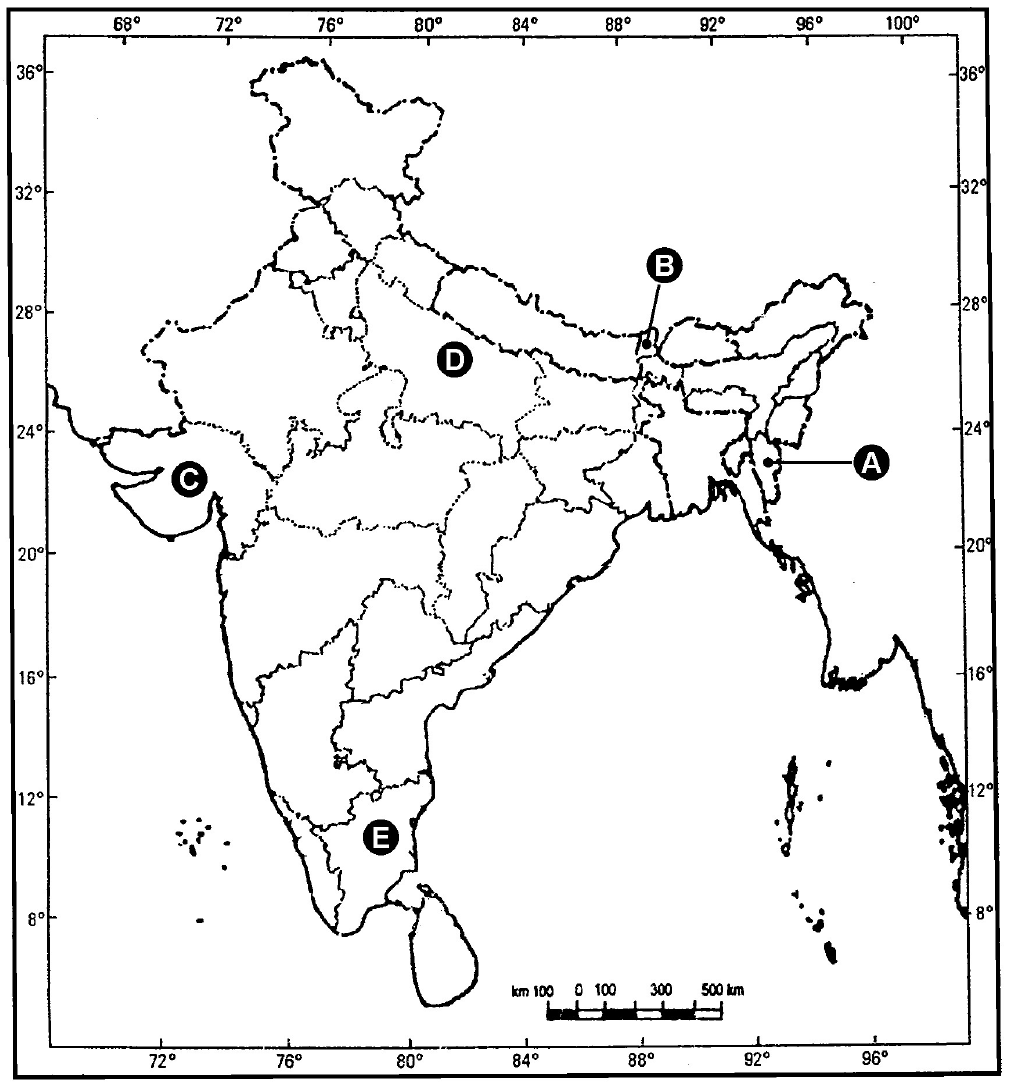
In the political outline map of India given above, five states have been marked as A, B, C, D and E. Identify these states on the basis of information given below and write their correct names in your answer book along with the respective serial number of the information used and the concerned alphabet in the map as per the following format.
Sr. No. of the information used
Concerned alphabet in the Map
Name of the State
i.
 
 
ii.
 
 
iii.
 
 
iv.
 
 
v.
 
 
  1. The state where a violent incident took place at Godhara in $2002$.
  2. The state which was earlier known as Madras.
  3. The state which has the maximum number of seats in India in its Legislative Assembly.
  4. The state to which Laldenga belonged.
  5. The state which integrated with India in $1975$ as $22^{nd}$ State of India.
Examine the U.S. hegemony as a structural power.
Name any two founders of Non-Aligned Movement (NAM). The first NAM summit was the culmination of which three factors?
What are the constraints on American hegemony today? Which one of these do you expect to get more important in the future?
Read the passage and answer the questions below:Indian democracy was never so close to a two-party system as it was during the 1977 elections. However, the next few years saw a complete change. Soon after its defeat, the Indian National Congress split into two groups……….. … … …The Janata Party also went through major convulsions…..David Butler, Ashok Lahiri and Prannoy Roy. — PARTHA CHATTERJEE
  1. What made the party system in India look like a two-party system in 1977?
  2. Many more than two parties existed in 1977. Why then are the authors describing this period as close to a two-party system?
  3. What caused splits in Congress and the Janata parties?
Suppose you are looking after the foreign policy of India. Which four values will you like to integrate into the foreign policy?
Read the following passage carefully and answer the following questions:
When India conducted its first nuclear test, it was termed as peaceful explosion. India argued that it was committed to the policy of using nuclear power only for peaceful purposes. The period when the nuclear test was conducted was a difficult period in domestic politics. Following the Arab-Israel War of 1973, the entire world was affected by the Oil Shock due to the massive hike in the oil prices by the Arab nations. It led to economic turmoil in India resulting in high inflation.
  1. When did India conduct its first nuclear test and why?
  2. Why was the period, when the nuclear test was conducted in India, considered to be a difficult period in domestic politics?
  3. Which international event of the 1970s was responsible for high inflation in India?
Explain the circumstances that led to the accession of Hyderabad to India.