Question
  1. Name a metal for each case:
  1. It does not react with cold as well as hot water but reacts with steam.
  2. It does not react with any physical state of water?
  1. When calcium metal is added to water, the gas evolved does not catch fire but the same gas evolved on adding sodium metal to water catches fire. Why is it so?

Answer

  1.  
  1. Aluminium does not react with cold or hot water but it reacts with steam.
  2. Gold does not react with any physical state of water.
  1. Sodium is more reactive than calcium. The reaction between sodium and water produces a large amount of heat, which causes the evolved hydrogen to burn and catch fire. But in the reaction between calcium and water, no heat is produced and hence the evolved hydrogen does not catch fire.

Need a full question paper?

Generate a complete, print-ready paper with questions like this in minutes — across 16+ boards, with answer keys.

Start Generating Free

Similar questions

Take a battery, (12V) a variable resistance (or a rheostat), an ammeter (0_5 A), a plug key, needle and a long straight thick copper wire. Take a rectangular cardboard, pass this wire through center. Fix the cardboard and see that it does not slide up or down. Sprinkle iron filings uniformly on the cardboard. Close the key and tap the cardboard gently.
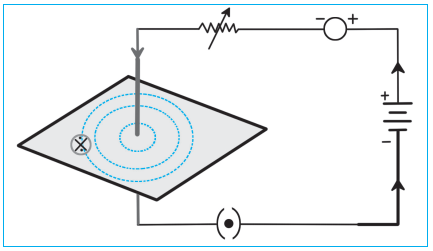
Image
(i) Observe the pattern of iron filings.
(ii) What changes are seen in the magnetic field lines?
(iii) What happens to the magnetic needle of the compass when the compass is brought near the wire, and moved away from the wire? Also observe what happens to the magnetic needle when strength of current is increased.
(iv) What happens to the magnetic needle of the compass when direction of the current is reversed in the straight conductor? State the reasons for your observation.
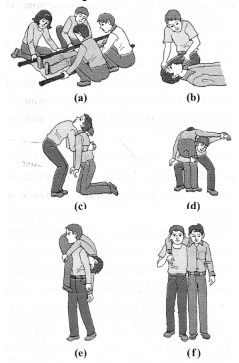
Give the reference of following pictures and explain importance of each of those in disaster management. Which are other such activities ?
Image
A concave mirror produces a real image $1\ cm$ tall of an object $2.5\ mm$ tall placed $5\ cm$ from the mirror. Find the position of the image and the focal length of the mirror.
Explain the following terms with example: Functional group.
What do we learn from the story of Jadav Molai Payeng?
Show how you would connect two 4 ohm resistors to produce a combined resistance of:
  1. 2 ohms.
  2. 8 ohms.
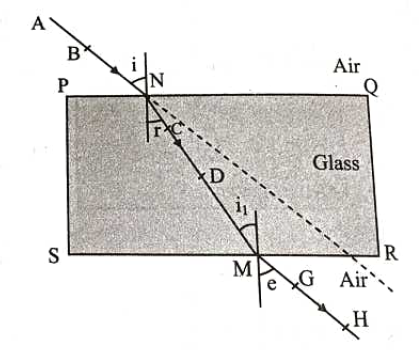
Observe the figure and name the ray AB , ray CD, ray GH:
Image
Column I Column II
1. The right hand thumb rule a. The direction of the force on a current-carrying conductor placed in a magnetic field.
2. Fleming’s right hand rule b. The direction of the magnetic field around a straight conductor carrying a current.
3. Fleming’s left hand rule c. The direction of induced current in a conductor.
Metals are said to be shiny. Why do metals generally appear to be dull ? How can their brightness be restored?
Balanced equation