Question
Name and explain different types of reserves in details.

Answer

Types of Reserves:
  1. Revenue Reserve: It is an amount set aside out of revenue profits for distribution of dividends. For example, general reserve, investment fluctuation fund, capital reserve and workmen compensation fund. It is not a charge against profit but it is appropriation of profit shown in the profit and loss account. It is beneficial for the smooth function of the business. The retention of profit in the form of reserves reduces the amount of profit to distribute among the business owners. This is further classified in to general reserve and specific reserve.
  • General reserve Means a reserve which is not maintained for specific purpose. It helps to strengthen the financial status of the business. It is also known as free reserve and contingency reserve.
  • Specific reserve Means a reserve which is maintained for specific purpose. For example, dividend equalisation reserve is created to maintain dividend rate. This reserve amount is utilised to maintain the rate dividend in the year of low profit. Likewise, the workmen compensation fund is maintained to provide claims of the workers, investment fluctuation fund is used at times of decline in the value of investment and debenture redemption reserve is used to provide funds for redemption of debentures.
  1. Capital Reserve: It is an amount set aside out of capital profits which is not available for distribution as dividend among the shareholders. It is used for writing capital losses/ issue of bonus share in a company. Examples of capital reserves are.
  • Profit prior to incorporation.
  • Premium on issue of shares or debentures.
  • Profit on redemption of debenture.
  • Profit on forfeiture of share.
  • Profit on sale of fixed assets.
  • Capital redemption reserve.
  • Profit on revaluation of fixed assets and liabilities.

Need a full question paper?

Generate a complete, print-ready paper with questions like this in minutes — across 16+ boards, with answer keys.

Start Generating Free

Similar questions

On July 1, 2016 Pushpak Ltd. purchased a machinery for ₹ 5,70,000 and paid ₹ 30,000 for its overhauling and installation. Depreciation is provided @20% p.a. on Original Cost Method and the books are closed on 31st March every year. The machine was sold on 31st January 2019 for a sum of ₹ 1,60,000. You are required to show the Machinery Account and Provision for Depreciation Account for three years.
Prepare Simple Cash Book from the following transactions of Suresh, Delhi:
2019
 
April 1
Suresh commenced business with cash
80,000
April 3
He bought goods
50,000
April 5
Sold goods for Cash
40,000
April 6
Received cash from Mr. Manohar
3,600
April 9
Paid into Bank
30,000
April 13
Paid cash to Harikrishan
2,150
April 17
Paid for stationery
200
April 18 Paid for office furniture 3,000
April 21 Received from Mr. Kailash Chand 6,800
April 22 Paid for advertising 1,008
April 25 Purchased postage stamps 80
April 28 Paid Rent 1,120
April 30 Paid electricity charges 150
Following balances appeared in the books of Radhika Traders as on 1st April, 2017:
Assets: Cash ₹ 8,000; Cash at Bank ₹ 7,000; Stock ₹ 30,000; Debtors; ₹ 36,000 (Mohan ₹ 10,000; Sohan ₹ 12,000; Dinesh ₹ 14,000); Furniture ₹ 5,000; Building ₹ 25,000.
Liabilities: Creditors− X ₹ 5,000; Y ₹ 6,000.
In April, 2017, the following transaction took place:
2017
 
April 2
Bought goods of the list price of ₹ 6,000 from Khanna Brothers less 15% trade discount and 2% cash discount and paid 40% price at the same time.
 
April 3
Received a draft from Mohan in full settlement and deposited it into Bank
 
April 5
Purchased goods from Suresh of the list price of ₹ 8,000 at 20% trade discount and paid him by cheque.
9,750
April 8
Sold goods and received a cheque
25,000
April 10
Deposited the above cheque into Bank
12,000
April 12
Sohan deposited in our Bank A/c
4,000
April 16
Paid Income Tax by Cheque
5,600
April 20 Received a cheque from Sohan and sent to Bank 7,800
Discount allowed 200
April 21
Withdrew from Bank−for office
2,000
for private use
4,000
April 23
Sent a cheque to X in full settlement of his A/c
4,900
April 27
Cheque of Sohan returned by the bank as dishonoured.
 
April 28
Dinesh was declared insolvent and a payment of 60 paise in a ₹ received from his estate by a Cheque
 
April 30
Bank allowed Interest
350
Paid for Rent by cheque
1,500
Paid for traveling expenses by cheque
500
Pass Journal entries for the above transactions.
Give the rules of Debit and Credit and explain them with imaginary examples.
Under Double Entry System of accounting each transaction has two aspects. One aspect is debit, i.e., receiving or incoming aspect. Another aspect is credit, i.e., giving or outgoing aspect. Debit and credit aspects of a transaction form the basis of Double Entry System.
Rules of Double Entry or Rules of Debit and Credit are formed on the basis of these two aspects in each of the business transactions. There are two approaches for deciding when to write on the debit side of account and when to write on the credit side of an account, i.e., which account is to be debited and which account is to be credited. The rules or: the basis of which such decision is taken are called Rules of Debit and Credit.
Rules of Debit and Credit (Traditional Classification) at a Glance:
S.No
Types of Account
Account to be Debited
Account to be Credited
1
Personal Account
Receiver
Giver
2
Real Account
What comes in
what goes out
3
Nominal Account
Expense and Loss
Income and Gain
From the following transactions, state the nature of accounts and state which account will be debited and which account will be credited:
S.No  
1
Mohan started business with cash
5,00,000
2
Purchased goods for cash
1,00,000
3
Sold goods for cash
1,50,000
4
Received interest from Ram in cash
500
5
Sold goods to Ashok
60,000
6
Purchased furniture for cash
50,000
7
Paid wages
20.000
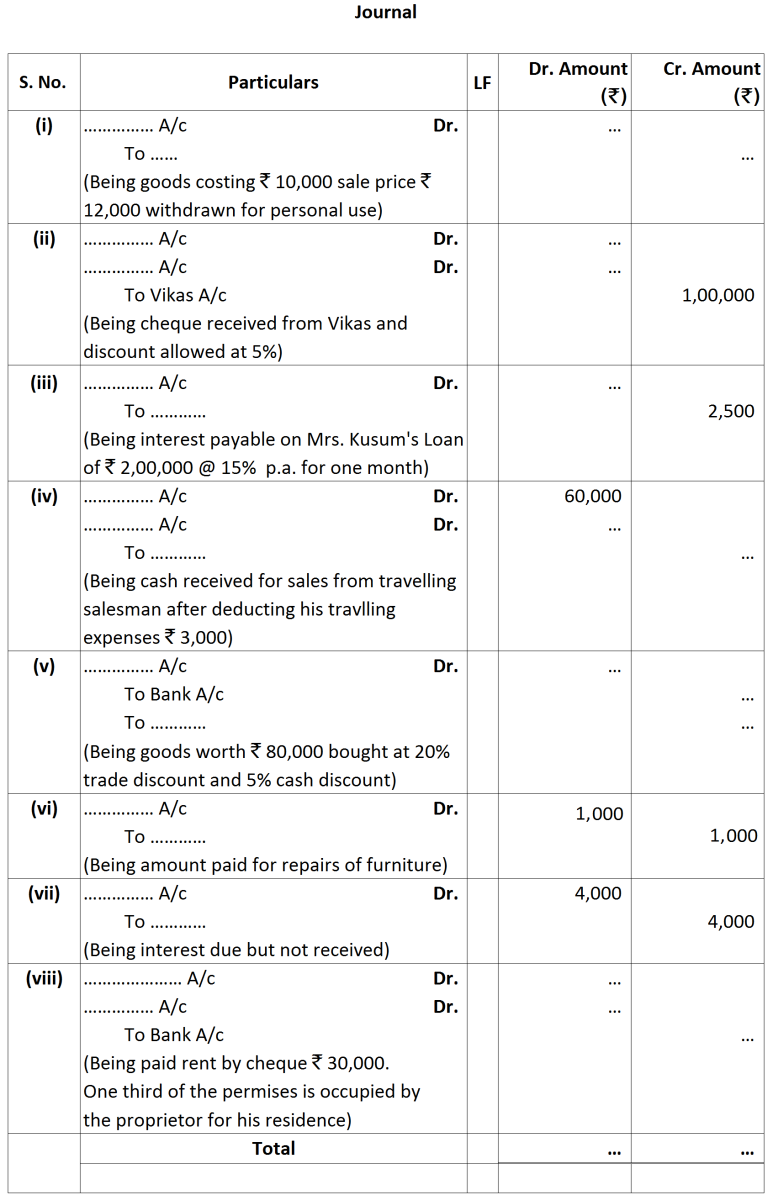
Fill in the missing information in the following journal entries:
Prepare bank reconciliation statement of Dinesh on 30th June 2014 with following particulars:
  1. Pass Book showed an overdraft of ₹ 15,000 on 30th June 2014.
  2. A cheque of ₹ 200 was deposited in bank but not recorded in Cash Book.
  3. Cheques of ₹ 17,000 were issued but cheques worth only ₹ 10,000 were presented for payment up to 30th June 2014.
  4. Cheques of ₹ 2,000 were received and recorded in Cash Book but not sent to bank.
  5. Cheques of ₹ 10,000 were sent to bank for collection; out of these cheques of ₹ 2,000 and of ₹ 1,000 were credited respectively on 8th July and 10th July and the remaining cheques were credited before 30th June 2014.
  6. Bank paid ₹ 300 fee of Chamber of Commerce on behalf of Dinesh, which was not recorded in Cash Book.
  7. Bank charged interest on overdraft ₹ 800 which was not recorded in Cash Book.
  8. ₹ 40 for bank charges were recorded two times in Cash Book and bank expenses of ₹ 35 were not at all recorded in Cash Book.
  9. Total of credit side of bank column of Cash Book was undercast by ₹ 1,000 by mistake.
Discuss the principle based on the premise "do not anticipate profits but provide for all losses."
Enter the following transactions in the Cash Book with Cash and Bank Columns:
2019
 
April 1
Balance of Cash in hand ₹ 4,000, overdraft at Bank ₹ 50,000.
April 4
Invested further capital ₹ 1,00,000 out of which ₹ 60,000 deposited into the bank.
April 5
Sold goods for cash ₹ 30,000 plus CGST and SGST @ 6% each.
April 10
Purchased goods ₹ 55,000 plus CGST and SGST @ 6% each and issued a cheque for the same.
April 11
Paid to Ram Vilas, our creditor ₹ 25,000; discount allowed by him ₹ 1,000.
April 14
Rent of ₹ 8,000 plus CGST and SGST @ 6% each paid by cheque.
April 15
Office Furniture purchased and a cheque of ₹ 22,400 issued for the same including CGST and SGST @ 6% each.
April 16
Drew cheque for personal use ₹ 5,000.
April 18
Collection from Atul ₹ 15,000, deposited in the bank on 19th April.
April 20
Goods sold to Amritraj for ₹ 80,000 plus CGST and SGST @6% each.
April 25
Received a cheque of ₹ 88,000 from Amritraj in full settlement of his account; deposited into bank on 28th April.
April 29
Drew from the bank for salary of the office staff ₹ 25,000.
April 29
Paid salary of the manager by cheque ₹ 10,000.
Compile a Two Column Cash Book from the following transactions of Kavita Garments:
2017
 
Feb. 1
Cash in hand ₹ 7,500; Cash at bank ₹ 8,000
Feb. 3
Received a cheque of ₹ 5,880 for cash sales. Cheque was immediately deposited into bank
Feb. 5
Received two cheques from Kalpna each of ₹ 10,000
Feb. 6
First cheque received from Kalpna is endorsed to Sunita in full settlement of ₹ 10,200
Second cheque is sent to bank for collection
Feb. 8
Second cheque received from Kalpna is returned as dishonoured by the bank
The bank has debited our account with ₹ 20 as bank charges on this cheque
Feb. 10
Received cheque from sale of old furniture ₹ 1,950. Next day, the cheque is endorsed to a creditor Ramesh in full settlement of ₹ 2,000 due to him
Feb. 12
Purchased goods from Mohan on Credit for ₹ 8,000
Feb. 15
Settled Mohan's account by giving a cheque for ₹ 4,000 and Cash ₹ 3,900
Feb. 16
Goods sold to Pawan for ₹ 6,000. He paid the amount in cash immediately after deducting $2\frac{1}{2}\%$ cash discount
Feb. 20
Paid salary by cheque ₹ 5,000
Feb. 25
Cash sale to date ₹ 50,000 of which ₹ 40,000 banked
Feb. 26
Paid electric bill of ₹ 2,000 for January by cheque. Paid Rent for January ₹ 1,500
Feb. 27
Cash purchases ₹ 5,000, issued a cheque
Feb. 28
Deposited into bank cash retaining ₹ 7,500
Show an Accounting Equation for the following transactions:
  1. D. Mahapatra commenced business with cash ₹ 50,000 and ₹ 1,00,000 by cheque; goods ₹ 60,000; machinery ₹ 1,00,000 and furniture ₹ 50,000.
  2. $\frac{1}{3^{rd}}$ of above goods sold at a profit of 10% on cost and half of the payment is received in cash.
  3. Depreciation on machinery provided @ 10%.
  4. Cash withdrawn for personal use ₹ 10,000.
  5. Interest on drawings charged @ 5%.
  6. Goods Sold to Gupta for ₹ 10,000 and received a Bill Receivable for the same amount for 3 months.
  7. Received ₹ 10,000 from Gupta against the Bills Receivable on its maturity.