Question
Name any two chromosomal aberration associated disorders.

Answer

Two chromosomal aberration–associated disorders are Down’s syndrome and Klinefelter’s syndrome.

Need a full question paper?

Generate a complete, print-ready paper with questions like this in minutes — across 16+ boards, with answer keys.
Start Generating Free

Similar questions

  1. Name the specific cellular components, where phosphorus is in abundance in living organisms.
  2. Name the natural reservoir of phosphorus.
  3. Explain the phosphorus cycle.
Draw the structure of HIV virus of AIDS and give its transmission, symptoms and treatment.
OR
Draw a labeled picture of HIV. Describe its structure.
Answer the following questions:
Explain the role of ovarian hormones in inducing changes in the uterus during menstrual cycle.
Describe the difference between the structures of a dicot embryo and monocot embryo. Also draw LS of monocot and dicot seeds.
How is the placenta connected to the embryo?
Read the following and answer any four questions from (i) to (v) given below:

Gene therapy is the technique of genetic engineering to replace a faulty gene by a normal healthy functional gene. It is a way of treating genetic disease by introducing a piece of DNA into the cells of an affected individual. Liposomes can be used for gene therapy as they target the cells affected by a genetic disease.

  1. A patient suffers from adenosine deaminase (ADA) deficiency, an autosomal recessive immune deficiency in which bone marrow lymphoblasts cannot replicate to generate immuno-competent lymphocytes. The treatment option that would cure the patient is:
  1. Germ-line gene therapy to replace one ADA gene copy.
  2. Germ-line gene therapy to replace both ADA gene copies.
  3. Somatic cell gene therapy to replace both ADA gene copies in circulating lymphocytes.
  4. Somatic cell gene therapy to replace one ADA gene copy in bone marrow lymphoblasts.
  1. Which type of gene therapy is least effective in transferring DNA to the nucleus?
  1. Adenoviruses.
  2. DNA attached to a ligand.
  3. Liposomes.
  4. Retroviruses.
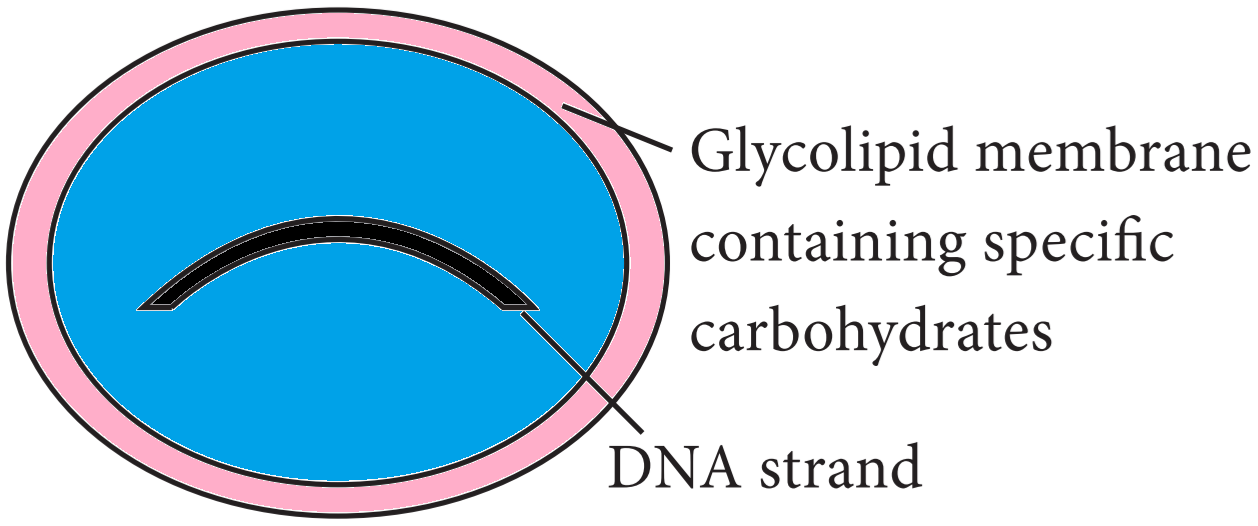
  1. Liposomes can be used for gene therapy as they target the cells affected by a genetic disease. The diagram shows the structure of a liposome.

What feature of a cell surface membrane allows the liposome to target cells affected by a genetic disease? 

  1. Carrier molecules.
  2. Phosphate groups.
  3. Protein channels.
  4. Receptor molecules.
  1. Which of the following disorders would gene therapy be least effective?
  1. Cystic fibrosis.
  2. Huntington's disease.
  3. Sickle cell anaemia.
  4. Type II diabetes.
  1. Following are some reasons explaining why gene therapy is not yet fully an effective treatment for genetic diseases.
  1. Lack of knowledge of DNA sequences.
  2. Lack of efficient and safe gene delivery system.
  3. Cost of the technology.
  4. Some diseases involve multiple genes.
  5. Problems with appropriate gene regulation.

Select the correct option. 

  1. I, III and V only
  2. II, IV and V only
  3. Ill, IV and V only
  4. I, III and IV only
Rose plants produce large, attractive bisexual flowers but they seldom produce fruit. On the other hand, Lady’s finger produces plenty of fruits. Analyse the reasons for failure of fruit formation in rose.
A child suffering from thalassemia is born to a normal couple. But the mother is being blamed by the family for delivering a sick baby.
  1. What is Thalassemia?
  2. How would you counsel the family not to blame the mother for delivering a child suffering from this disease? Explain.
  3. List the values your counselling can propagate in the families.
(i) Define translation.
(ii) Explain the translation process.
(iii) Draw a labelled diagram of the translation.
Unless the vector and source DNAs are cut, fragments separated and joined, the desired recombinant vector molecules cannot be created.
  1. How are the desired DNA sequences cut?
  2. Explain the technique used to separate the cut fragments.
  3. How are the resultant fragments joined to the vector molecule?