Question
Name the common defects of the eye.

Answer

Common defects of the eye:
(i) Near or short-sightedness (Myopia)
(ii) Far or long-sightedness (Hypermetropia)
(iii) Astigmatism.
(iv) Presbyopia.
(v) Night blindness.
(vi) Colour blindness.
(vii) Squint.
(viii) Cataract.

Need a full question paper?

Generate a complete, print-ready paper with questions like this in minutes — across 16+ boards, with answer keys.
Start Generating Free

Similar questions

Predict the genotype and phenotype of the following cross in pea.
TtRr x TtRr
(Capital letters show dominance)
Elucidate "Law of independent Assortment". Explain how Mendel achieved it.
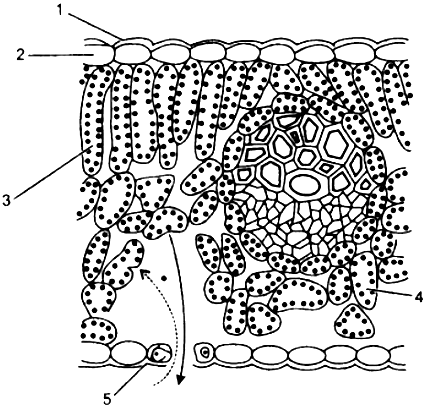
The figure below represents the vertical section of a leaf:

(i) Name the parts labeled 1 to 5.
(ii) What do the two arrows (dotted and solid) indicate in the day time and at night?
(iii) Could you add one more arrow in the figure? If yes, what for?
(iv) How many leaf veins have been shown in this section?
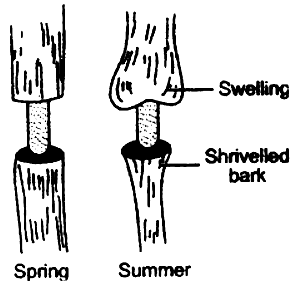
A complete ring of bark was removed from a tree in spring. The tree continued to live through summer but a swelling appeared on the bark above the ring while the bark below shriveled up. Answer the questions given below :

(i) Account for the swelling in the bark above the ring.
(ii) Account for the shrinking of the bark below the ring.
(iii) Name the tissue that distributes food in plants.
(iv) Name the tissue that distributes water in plants.
(v) What is the role of a bark in a plant?
Differentiate Between Transpiration and Evaporation.
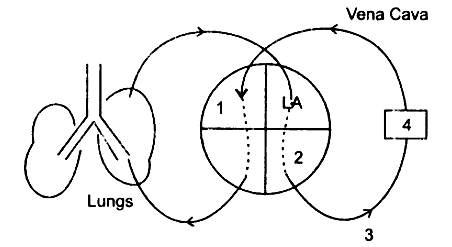
Given below is a schematic representation of the circulatory system in man. Study the same and answer the questions that follow:

(i) Label the parts 1 to 4 indicated in the diagram.
(ii) Give one difference between parts 1 and 2 based on:
(a) their structure
(b) the nature of blood flowing through them.
(iii) What is the specific name of the type of blood circulation that takes place between the heart and the lungs?
(iv) Name the valve found at the beginning of the part labeled 3.
Match the events given in column A with the phase in mitotic cell division in column B
Column ‘A’ Column ‘B’
1Chromosomes get arranged in a horizontal plane at the equator.aProphase
2Daughter chromosomes move to the opposite poles of a spindle.bAnaphase
3Chromosomes become visible as fine long threads. cMetaphase
4Chromosomes lose their distinctiveness and gradually
become transformed into a chromatin network.
d Telophase
Compare meiotic and mitotic telophase.
List some adaptations found in desert plants to reduce transpiration.
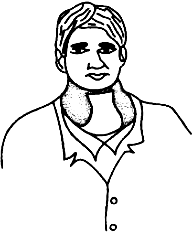
The sketch below shows a certain condition in an individual:

(i) Name the condition.
(ii) What is the underlying cause of this condition?
(iii) Name two other conditions that could have resulted due to a similar cause.
(iv) Which hormone is required for iodine synthesis?
(v) Where is the thyroid gland located?
(vi) The hormone secreted by the thyroid gland is controlled from which hormone?