MCQ
Name the compound, that is not isomer with diethyl ether
  • A
    $n-$propylmethyl ether
  • B
    Butane$-1-$ol
  • C
    $2-$methylpropane$-2-$ol
  • Butanone

Answer

Correct option: D.
Butanone
d
(d) Butanone $\mathop {C{H_3} - \mathop {\mathop C\limits_{|\,|} }\limits_O - C{H_2} - C{H_3}\,}\limits_{} ({C_4}{H_8}O)$ is not an isomer of ${C_2}{H_5} - O - {C_2}{H_5}\,({C_4}{H_{10}}O)$

Need a full question paper?

Generate a complete, print-ready paper with questions like this in minutes — across 16+ boards, with answer keys.
Start Generating Free

Similar questions

$R - N{H_2} \to R - NH - C{H_3}$ (major product) The corret sequence of reagent is
$\begin{matrix}
   O\,\,\,\,\,\,\,\,\,\,\,\,\,\,\,\,\,\,\,\,\,\,\,\,\,\,\,\,\,\,\,\,\,\,\,\,\,\,\,\,\,\,\,\,\,\,\,\,\,\,\,\,\,\,\,\,\,\,\,\,\,\,\,\,\,\,\,\,\,\,\,\,\,\,\,\,\,\,\,\,\,\,\,\,\,\,  \\
   ||\,\,\,\,\,\,\,\,\,\,\,\,\,\,\,\,\,\,\,\,\,\,\,\,\,\,\,\,\,\,\,\,\,\,\,\,\,\,\,\,\,\,\,\,\,\,\,\,\,\,\,\,\,\,\,\,\,\,\,\,\,\,\,\,\,\,\,\,\,\,\,\,\,\,\,\,\,\,\,\,\,\,\,\,\,\,\,  \\
   C{{H}_{3}}-C-O-C{{H}_{2}}-C{{H}_{3}}+H-{{\bullet }^{-}}\to (\bullet ={{O}^{18}})  \\
\end{matrix}$ One of the product of the reaction is
A compound contains atoms $X,\,\,Y,\,\,Z.$ The oxidation number of $X$ is $sp - s{p^2}$ is $+ 5$ and $Z$ is $ - \,2$. Therefore, a possible formula of the compound is
Among the following, the least stable resonance structure is
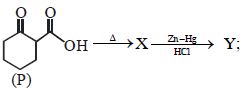
$Y$ is
A solution is prepared by dissolving $24.5\, g$ of sodium hydroxide in distilled water to give $1\, L$ solution. The molarity of $NaOH$ in the solution is (Given that molar mass of $NaOH = 40.0\,g\,mol^{-1})$
What is the work function of the metal if the light of wavelength $4000\, \mathop A\limits^o $ generates photoelectrons of velocity $6\times10^5\, ms^{-1}$ from it? ............. $\mathrm{eV}$ (Mass of electron $= 9\times10^{-31}\, kg$ Velocity of light $= 3\times10^8\, ms^{-1}$ Planck’s constant $= 6.626\times10^{-34}\, Js$ Charge of electron $= 1.6\times10^{-19}\, J\,eV^{-1}$)
$STATEMENT$-$1$: Boron always forms covalent bond.

because

$STATEMENT$-$2$: The small size of $\mathrm{B}^{3+}$ favours formation of covalent bond.

Identify wrong statement

$\begin{array}{*{20}{c}}
  {C{H_3} - CH - CH = C{H_3}} \\ 
  {|\,\,\,\,\,\,\,\,\,\,\,\,\,\,\,\,\,} \\ 
  {C{H_3}\,\,\,\,\,\,\,\,\,\,\,\,} 
\end{array}\xrightarrow{{HBr}}A$

$\begin{array}{*{20}{c}}
  {C{H_3} - CH - CH = C{H_3}} \\ 
  {|\,\,\,\,\,\,\,\,\,\,\,\,\,\,\,\,\,} \\ 
  {C{H_3}\,\,\,\,\,\,\,\,\,\,\,\,} 
\end{array}\xrightarrow{{HBr + ROOR}}B$

$\begin{array}{*{20}{c}}
  {C{H_3} - CH - CH = C{H_3}} \\ 
  {|\,\,\,\,\,\,\,\,\,\,\,\,\,\,\,\,\,} \\ 
  {C{H_3}\,\,\,\,\,\,\,\,\,\,\,\,} 
\end{array}\xrightarrow{{NBS}}C$

In the reaction: ${H_2}S$ $\rightleftharpoons$ $2{H^ + } + {S^{ 2- }}$, when $N{H_4}OH$ is added, then