Question
  1. Name the first stable compound formed in sugarcane plant during CO2, fixation.
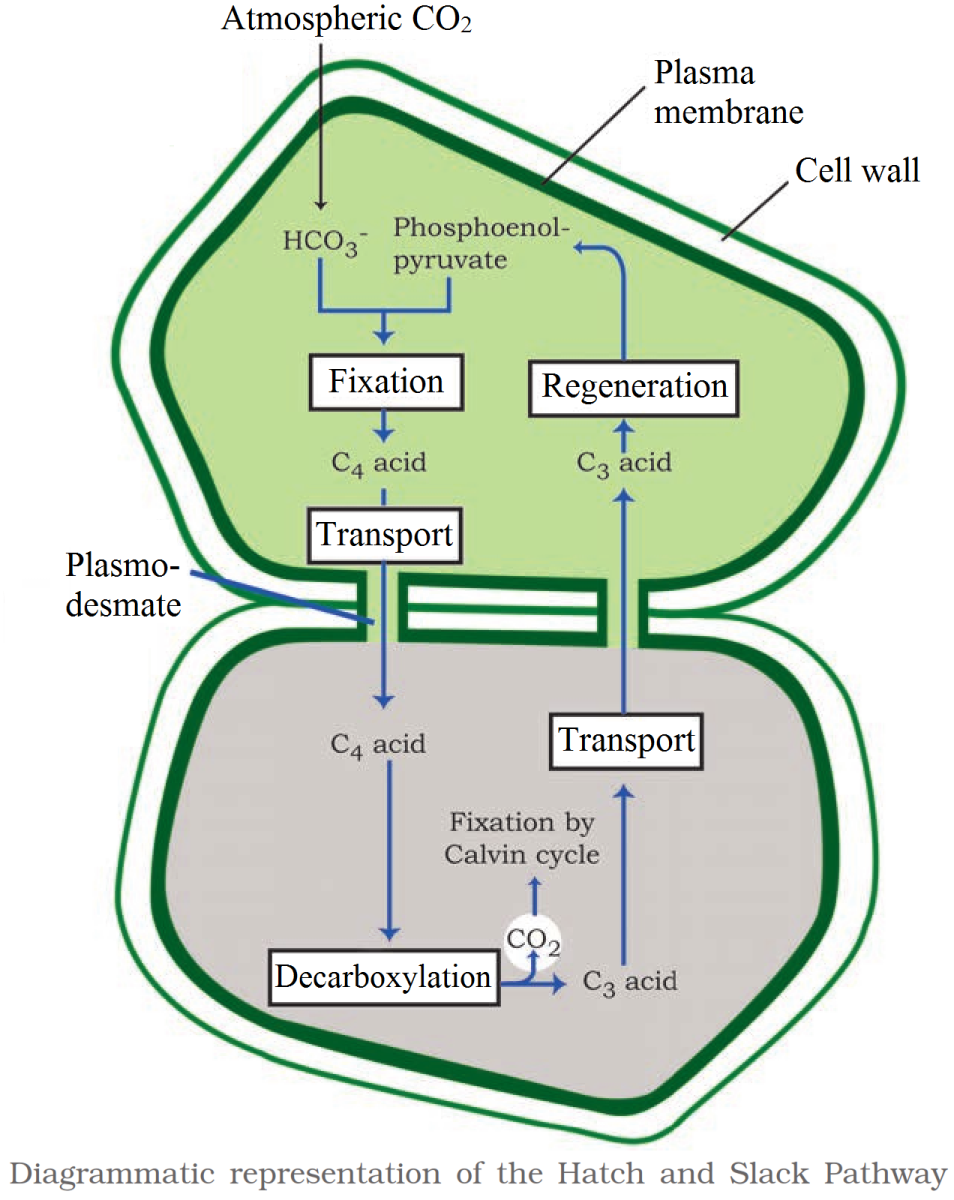
  2. Describe Hatch and Slack pathway of CO2, fixation.
Answer

  1. Oxaloacetic acid (OAA).
  2.  

  • Phosphoenol pyruvate (PEP) is the primary carbon dioxide acceptor present in the mesophyll cells; the reaction is catalysed by PEP-carboxylase and the first stable product is oxaloacetic acid (OAA) a 4C-compound.
  • OAA is converted into malic acid, which is transported to bundle sheath cells and decarboxylated to form pyruvic acid and carbon dioxide. The carbon dioxide enters the calvin cycle that is operating in the bundle sheath cells and sugars are formed.

Need a full question paper?

Generate a complete, print-ready paper with questions like this in minutes — across 16+ boards, with answer keys.
Start Generating Free

Similar questions

Briefly describe the cell theory.
Deepak, (student of XI class), attended a seminar on plant growth and development. As Deepak also belongs to the farmer's family, he was enthusiastic to know upcoming experiments in the field of botany. Guest of the seminar told the students that development in plants is under the control of various intrinsic and extrinsic factors. The intrinsic factors include intracellular or genetic factors as well as intercellular factors like plant growth regulators.
Deepak asked the guest about the role of growth regulators used to improve the yield of plants. The guest speaker cleared all doubts of Arun and then Arun returned home happily from the seminar he visited.
  1. What are the two groups of PGRs, based on their functions?
  2. Give an example of each of the two types.
  3. It is said that PGRs may function synergistically of antagonistically. What is meant by these two terms? Give an example for each.
  4. What value can be learnt by the nature of Deepak (as a XI class student).
Differentiate between
Glycolysis and Krebs’ cycle
Under what conditions are Cplants superior to C3?
Differentiate between haplontic and diplontic life cycles.
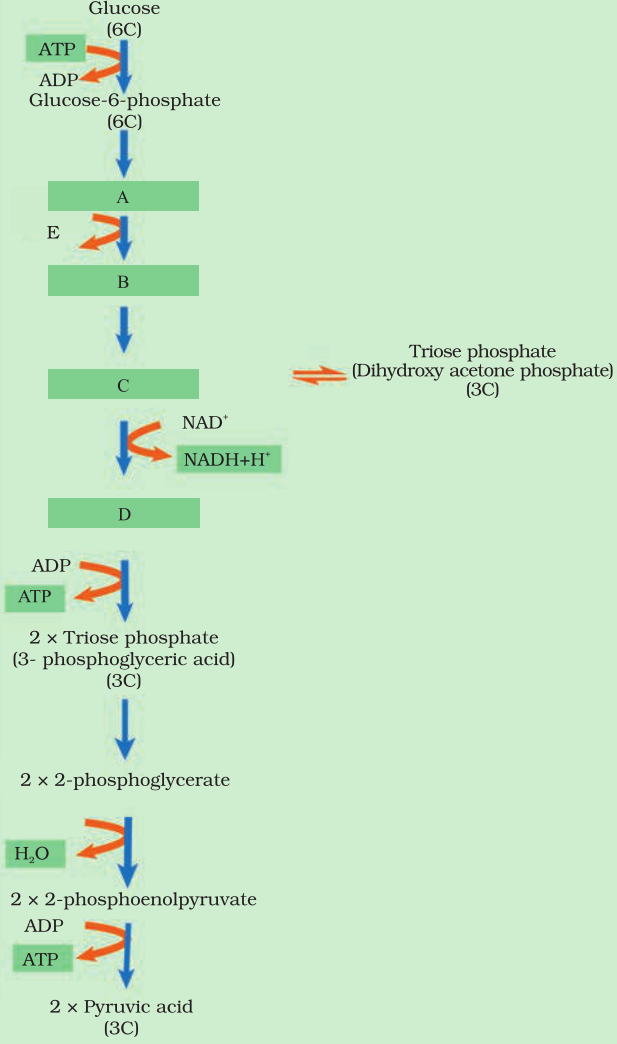
The figure given below shows the steps in glycolysis. Fill in the missing steps A, B, C, D and also indicate whether ATP is being used up or released at step E?

Explain the difference between Kingdom Monera and Kingdom Animalia.
Differentiate between the following: (i) red algae and brown algae, (ii) liverwort and moss, (iii) homosporous and heterosporous pteridophytes.
How have the terrestrial organisms adapted themselves for conservation of water?
Explain glycolysis.