Question
Name the fundamental forces of nature.

Answer

Gravitational force, Nuclear force, Electro-magnetic force and weak forces.

Need a full question paper?

Generate a complete, print-ready paper with questions like this in minutes — across 16+ boards, with answer keys.
Start Generating Free

Similar questions

The time of oscillation (t) of a small drop of liquid under surface tension depends upon the density $\rho,$ radius r and surface tension $\sigma.$ Prove dimensionally that to: $\text{t}\propto\sqrt{\frac{\rho\text{r}^3}{\sigma}}.$
Can you have $\overrightarrow{\text{A}}\times\overrightarrow{\text{B}}=\overrightarrow{\text{A}}\cdot\overrightarrow{\text{B}}$ with $\text{A}\neq0$ and $\text{B}\neq0?$ What if one of the two vectors is zero?
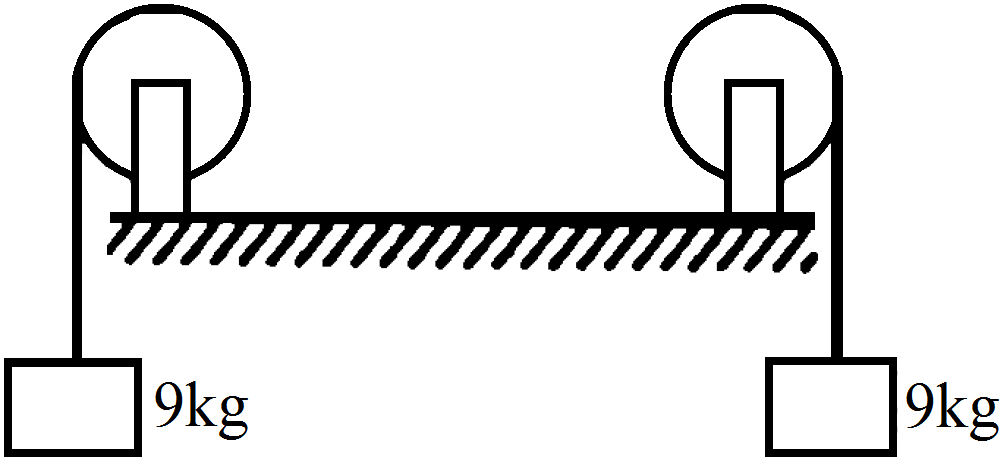
The length of the wire shown in figure, between the pulleys is 1.5m and its mass is 12.0g. Find the frequency of vibration with which the wire vibrates in two loops leaving the middle point of the wire between the pulleys at rest.
Can we conclude from the interference phenomenon whether light is a transverse wave or a longitudinal wave?
The kinetic energy of a particle vibrating in S.H.M. is 4J when it passes the mean position. If the mass of the body is 2kg and the amplitude is 1m, calculate its time period.
The frequencies of the two tuning forks A and B are 250Hz and 255Hz respectively. Both are sounded together. How many beats will be heared in 5s?
If three identical prisms are combined, is it possible to pass a beam that emerges undeviated? Undispersed?
Consider a gold nucleus to be a sphere of radius 6.9 fermi in which protons and neutrons are distributed. Find the force of repulsion between two protons situated at largest separation. Why do these protons not fly apart under this repulsion?
In general terrestrial experiments, which of the following observers are inertial and which are non-inertial?
(i) Pilot of an aircraft in flight.
(ii) A driver driving at a high steady speed of 200 km/h in a sports car on a straight road.
(iii) A cyclist taking a scissor turn.
(iv) The guard of a train slowing down and stopping at the station.
(v) A child moving in a big circle
If we put a cardboard (say 20cm × 20cm) between a light source and our eyes, we can't see the light. But when we put the same cardboard between a sound source and our ear, we hear the sound almost clearly. Explain.