Question
Name the indicator used in redox titration involving $\mathrm{K}_2 \mathrm{Cr}_2 \mathrm{O}_7$ as an oxidising agent.

Answer

Diphenyl amine is used as indicator which gives dark blue colour at end point.

Need a full question paper?

Generate a complete, print-ready paper with questions like this in minutes — across 16+ boards, with answer keys.
Start Generating Free

Similar questions

$\text{A}+\text{B}\rightleftharpoons\text{AB};\text{K}=1\times10^2$
$\text{E}+\text{F}\rightleftharpoons\text{EF};\text{K}=1\times10^{-3}$
Out of AB and EF, which one is more stable AB or EF?
  1. Which out of Cu, Fe, V, Ag is not in first transition series (3d series).
  2. Which element in Group 13 forms most acidic oxide? Give its formula.
What are non-benzanoid aromatic compounds? Explain with examples.
For each of the following pairs, predict which one has lower first ionisation enthalpy?
i. N or O
ii. Na or $\mathrm{Na}^{+}$
iii. $\mathrm{Be}^{+}$or $\mathrm{Mg}^{2+}$
iv. I or $I^{-}$
Suggest a route to prepare ethyl hydrogensulphate $(\text{CH}_3 – \text{CH}_2 – \text{OSO}_2 – \text{OH})$ starting from ethanol $(\text{C}_2\text{H}_5\text{OH})$.

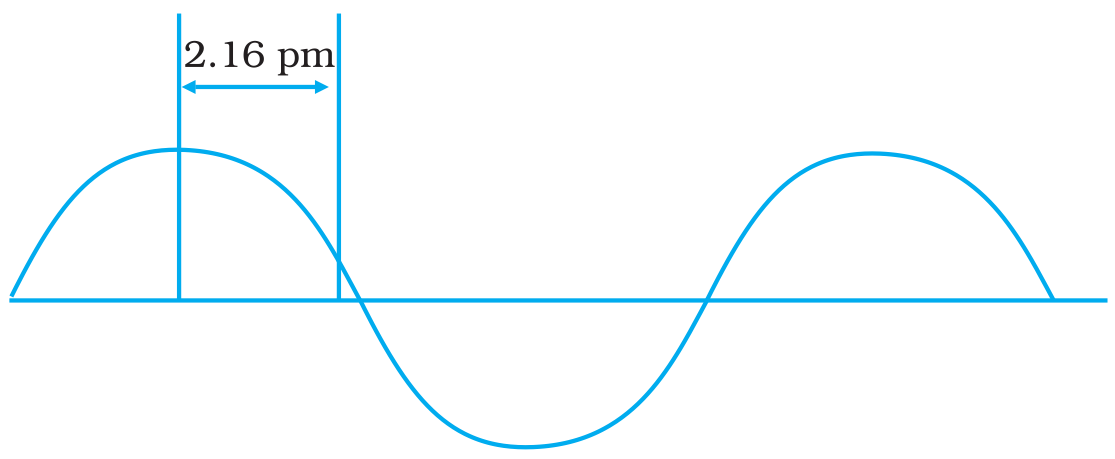
A hypothetical electromagnetic wave is shown in Fig. Find out the wavelength of the radiation.
The first $(\Delta_{1}\text{H}_{1})$ and the second $(\Delta_{1}\text{H}_{1})$ ionization enthalpies (in $\mathrm{kJ} \mathrm{~mol}^{-1}$ ) and the $(\Delta_{1}\text{H}_{1})$ electron gain enthalpy (in $\mathrm{kJ} \mathrm{~mol}^{-1}$ ) of a few elements are given below:
Elements $\Delta\text{H}_{1}$ $\Delta{\text{H}}_{2}$ $\Delta_{\text{eg}}\text{H}$
I 520 7300 -60
II 419 3051 -48
III 1681 3374 -328
IV 1008 1846 -295
V 2372 5251 +48
VI 738 1451 -40
Which of the above elements is likely to be:
The most reactive metal.
Balance the following reaction by ion electron method (half-reaction method).
$MnO _4^{-}( aq )+ H ^{+}( aq )+ Fe ^{2+}( aq ){+ H _2 O (l)}{\longrightarrow} Mn ^{2+}( aq )+Fe ^{3+}( aq )$
Write formula for the following compound:
Nickel(II) sulphate.
(a) Differentiate between dissociation and ionization.
(b) What is the relationship between dielectric constant of solvent and electrostatic force between ions?