Question

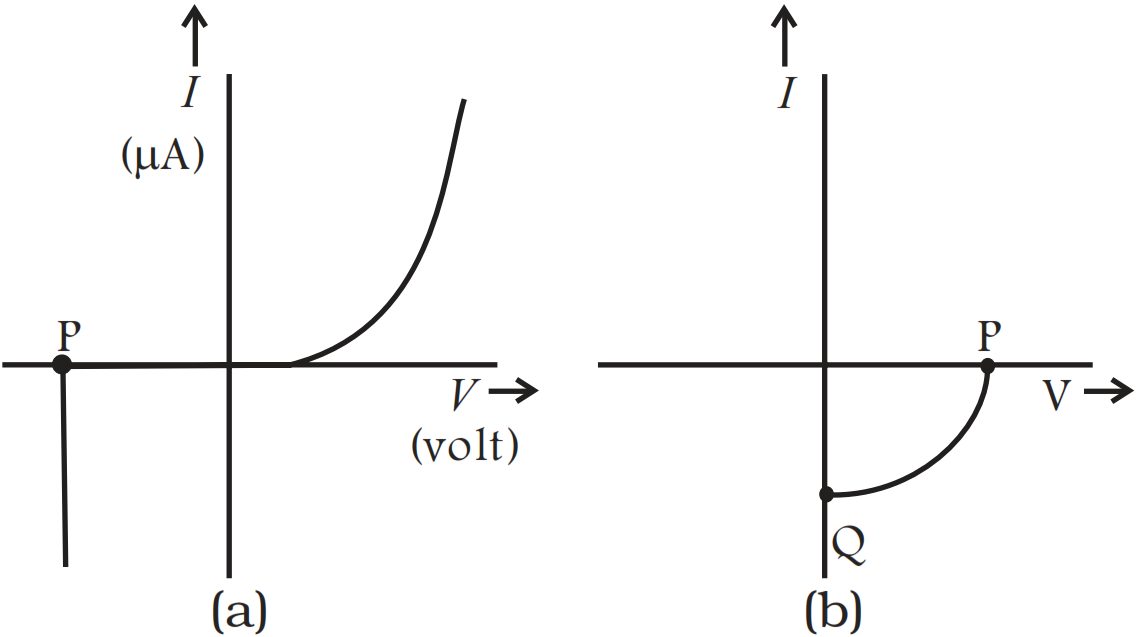
  1. Name the type of a diode whose characteristics are shown in Fig. (A) and Fig. (B).
  2. What does the point P in Fig. (A) represent?
  3. What does the points P and Q in Fig. (B) represent?

Answer

  1. Fig. (a) represents the characteristics of Zener diode and curve (b) is of solar cell.
  2. In fig. (a), point P represents Zener breakdown voltage.
  3. In fig. (b), the point Q represents zero voltage and negative current. Which means the light falling on solar cell with atleast minimum threshold frequency gives the current in opposite direction to that due to a battery connected to solar cell. But for the point Q the battery is short circuited. Hence it represents the short circuit current.
And the point Pin Fig. (b) represents some open circuit, voltage on solar cell with zero current through solar cell.
It means, there is a battery connected to a solar cell which gives rise to the equal and opposite current to that in solar cell by virtue of light falling on it.

Need a full question paper?

Generate a complete, print-ready paper with questions like this in minutes — across 16+ boards, with answer keys.
Start Generating Free

Similar questions

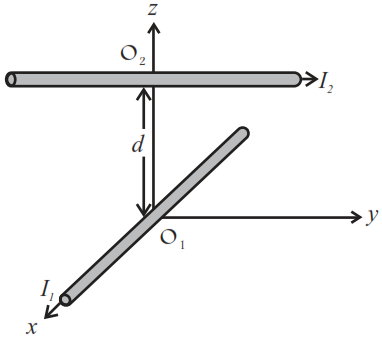
Two long wires carrying current $I_1$ and $I_2$ are arranged as shown in Fig. The one carrying current $I_1$ is along is the $x-$axis. The other carrying current $I_2$ is along a line parallel to the $y-$axis given by $x = 0$ and $z = d.$ Find the force exerted at $O_2$  because of the wire along the $x-$axis.
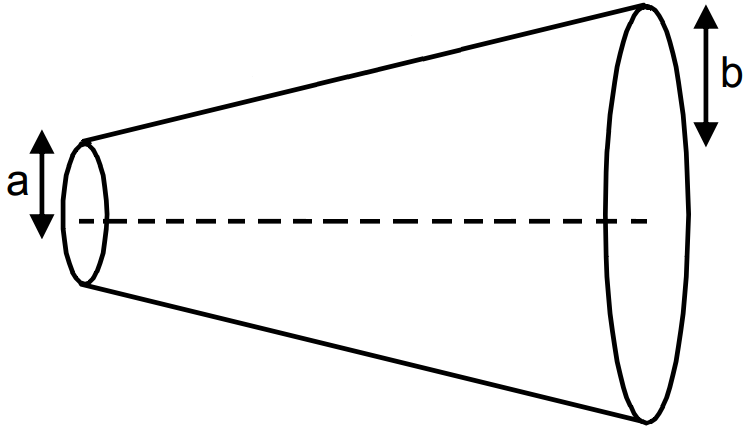
Figure. shows a conductor of length l with a circular cross-section. The radius of the cross-section varies linearly from a to b. The resistivity of the material is ρ. Assuming that b - a << l, find the resistance of the conductor.
A town has a population of $1$ million. The average electric power needed per person is $300W.$ A reactor is to be designed to supply power to this town. The efficiency with which thermal power is converted into electric power is aimed at $25\%.$
  1. Assuming $200\ MeV$ to thermal energy to come from each fission event on an average, find the number of events that should take place every day.
  2. Assuming the fission to take place largely through $^{235}U,$ at what rate will the amount of $^{235}U$ decrease? Express your answer in kg per day.
  3. Assuming that uranium enriched to $3\%$ in $^{235}U$ will be used, how much uranium is needed per month $(30$ days$)?$
For the $\beta^{+} ($positron$)$ emission from a nucleus, there is another competing process known as electron capture $($electron from an inner orbit, say, the $K–$ shell, is captured by the nucleus and a neutrino is emitted$).$
$\text{e}^{+}+^{\text{A}}_{\text{Z}}\text{X}\rightarrow\ ^{\text{A}}_{\text{Z}-1}\text{Y}+\text{v}$
Show that if $\beta^{+}$ emission is energetically allowed, electron capture is necessarily allowed but not vice $–$ versa.
  1. State Huygen’s principle. Using this principle draw a diagram to show how a plane wave front incident at the interface of the two media gets refracted when it propagates from a rarer to a denser medium. Hence verifiy Snell’s law of refraction.
  2. When monochromatic light travels from a rarer to a denser medium, explain the following, giving reasons:
    1. Is the frequency of reflected and refracted light same as the frequency of incident light?
    2. Does the decrease in speed imply a reduction in the energy carried by light wave?
$a$ . Derive an expression for the potential energy of an electric dipole in a uniform electric field. Explain conditions for stable and unstable equilibrium.
$b$ . Is the electrostatic potential necessarily zero at a point where the electric field is zero? Give an example to support your answer.
A pin of length 2.0cm lies along the principal axis of a converging lens, the centre being at a distance of 11cm from the lens. The focal length of the lens is 6cm. Find the size of the image.
A long, straight wire carries a current i. Let $B_1,$ be the magnetic field at a point Pat a distance d from the wire. Consider a section of length l of this wire such that the point $P$ lies on a perpendicular bisector of the section. Let $B_2$ be the magnetic field at this point due to this section only. Find the value of $\frac{\text{d}}{\text{l}}$ so that $B_2$ differs from $B_1,$ by $1\%.$
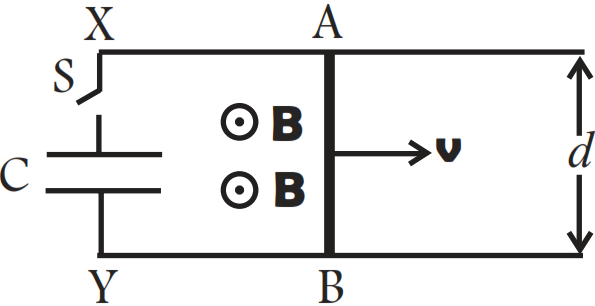
Find the current in the sliding rod AB (resistance = R) for the arrangement shown in Fig. B is constant and is out of the paper. Parallel wires have no resistance. v is constant. Switch S is closed at time t = 0.
How many time constants will elapse before the energy stored in the capacitor reaches half of its equilibrium value in a charging RC circuit?