Question

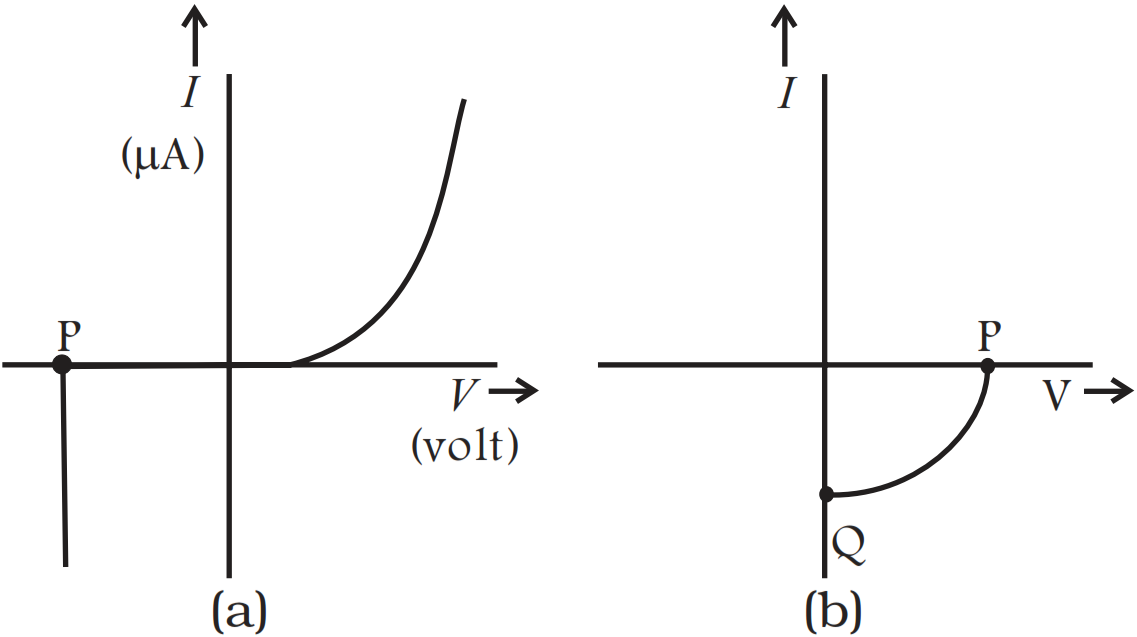
  1. Name the type of a diode whose characteristics are shown in Fig. (A) and Fig. (B).
  2. What does the point P in Fig. (A) represent?
  3. What does the points P and Q in Fig. (B) represent?

Answer

  1. Fig. (a) represents the characteristics of Zener diode and curve (b) is of solar cell.
  2. In fig. (a), point P represents Zener breakdown voltage.
  3. In fig. (b), the point Q represents zero voltage and negative current. Which means the light falling on solar cell with atleast minimum threshold frequency gives the current in opposite direction to that due to a battery connected to solar cell. But for the point Q the battery is short circuited. Hence it represents the short circuit current.
And the point Pin Fig. (b) represents some open circuit, voltage on solar cell with zero current through solar cell.

It means, there is a battery connected to a solar cell which gives rise to the equal and opposite current to that in solar cell by virtue of light falling on it.

Need a full question paper?

Generate a complete, print-ready paper with questions like this in minutes — across 16+ boards, with answer keys.
Start Generating Free

Similar questions

What is interference of light? Write two essential conditions for sustained interference pattern to be produced on the screen. Draw a graph showing the variation of intensity versus the position on the screen in Young's experiment when (a) both the slits are opened and (b) one of the slit is closed. What is the effect on the interference pattern in Young's double-slit experiment when: 32. 33.
i. Screen is moved closer to the plane of slits?
ii. Separation between two slits is increased. Explain.
Calculate potential on the axis of a disc of radius R due to a charge Q uniformly distributed on its surface.
A neutron moving with a speed υ strikes a hydrogen atom in ground state moving towards it with the same speed. Find the minimum speed of the neutron for which inelastic (completely or partially) collision may take place. The mass of neutron = mass of hydrogen $= 1.67 \times 10^{-27}kg.$
A rectangular loop of sides 20cm and 10cm carries a current of 5.0A. A uniform magnetic field of magnitude 0.20T exists parallel to the longer side of the loop.
  1. What is the force acting on the loop?
  2. What is the torque acting on the loop?
Two small spheres, each having a mass of 20g, are suspended from a common point by two insulating strings of length 40cm each. The spheres are identically charged and the separation between the balls at equilibrium is found to be 4cm. Find the charge on each sphere.
Find the ratio of the electric and gravitational forces between two protons.
What is the difference between cathode rays and beta rays? When the two are travelling in space, can you make out which is the cathode ray and which is the beta ray?
equiconvex lens (of refractive index 1.50) in contact with a liquid layer on top of a plane mirror. A small needle with its tip on the principal axis is moved along the axis until its inverted image is found at the position of the needle. The distance of the needle from the lens is measured to be 45.0 cm. The liquid is removed and the experiment is repeated. The new distance is measured to be 30.0 cm. What is the refractive index of the liquid?
At what angle should a ray of light be incident on the face of a prism of refracting angle 60° so that it just suffers total internal reflection at the other face? The refractive index of the material of the prism is 1.524.
The current−voltage characteristic of an ideal p-n junction diode is given by $\text{i}=\text{i}_0\Big(\text{e}^{\frac{\text{eV}}{\text{kT}}}-1\Big)$ where, the drift current $i_0$ equals $10\mu\text{A}.$ Take the temperature T to be 300K.
  1. Find the voltage $V_0$ for which $\text{e}^{\frac{\text{eV}}{\text{KT}}}=100.$ One can neglect the term 1 for voltages greater than this value.
  2. Find an expression for the dynamic resistance of the diode as a function of V for $V > V_0.$
  3. Find the voltage for which the dynamic resistance is $0.2\Omega.$