Question
Name three incurable sexually transmitted diseases and their causative organisms.

Answer

S. No.
Sexually transmitted disease
Causal agent
1.
Hepatitis–B
Hepatitis–B virus
2.
Genital herpes
Herpes simplex virus
3.
AIDS
HIV (Human Immunodeficiency Virus)

Need a full question paper?

Generate a complete, print-ready paper with questions like this in minutes — across 16+ boards, with answer keys.
Start Generating Free

Similar questions

By the end of 2002 the public transport of Delhi switched over to a new fuel. Name the fuel. Why is this fuel considered better? Explain.
Practise drawing various animals and plants.
Given below is a list of autotrophs and heterotrophs. With your knowledge about food chain, establish various linkages between the organisms on the principle of ‘eating and being eaten’. What is this inter-linkage established known as?
Algae, hydrilla, grasshopper, rat, squirrel, crow, maize plant, deer, rabbit, lizard, wolf, snake, peacock, phytoplankton, crustaceans, whale, tiger, lion, sparrow, duck, crane, cockroach, spider, toad, fish, leopard, elephant, goat, Nymphaea, Spirogyra.
How do accessory glands in man help in semen formation and reproduction process?
How is primary infertility different from secondary infertility?
  1. What is green revolution? Mention the steps that led to it.
  2. Name the scientist whose contribution led to the development of semi-dwarf wheat varieties in India.
  1. Why do the symptoms of malaria not appear immediately after the entry of sporozoites into the human body, when bitten by female Anopheles? Explain.
  2. Give the scientific name of the malarial parasite that causes malignant malaria in humans.
Define a climax community. How does a sere differ from a seral community?
Write the difference between Darwinism and De Vries theory about evolution of life on earth.
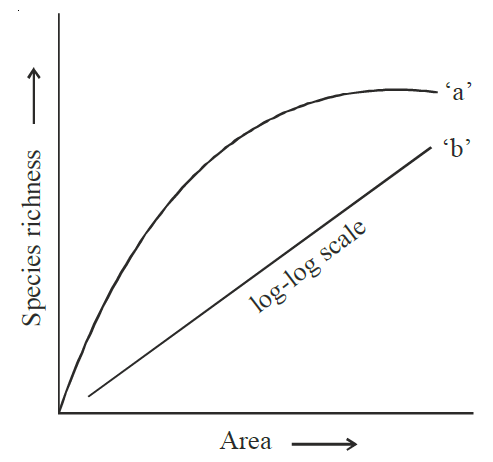
The following graph shows the species-area relationship. Answer the following question as directed.
  1. Name the naturalist who studied the kind of relationship shown in the graph. Write the observation made by him.
  2. Write the situations as discovered by the ecologists when the value of 'Z' (slope of the line) lies.
  1. 0.1 and 0.2
  2. 0.6 and 1.2
What does 'Z' stand for?
  1. When would the slope of the line 'b' become steeper?