Question
Name three main characteristics of an heating element.

Answer

The three main characteristics of an heating element are:
(i) It should have a high resistance so that a major amount of electric energy is converted into heat energy.
(ii) It should not get oxidised easily up to a temperature of 1000°C.
(iii) It should have a high melting point and a low thermal Expansion so that it does not get loosened on getting heated.

Need a full question paper?

Generate a complete, print-ready paper with questions like this in minutes — across 16+ boards, with answer keys.

Start Generating Free

Similar questions

The length of a nut-cracker is 12 cm. A nut, when kept at a distance of 4 cm from its fulcrum, requires an effort of 100 gf to crack it. What force will be required to crack the nut without using the nut-cracker?
Differentiate between heat and temperature.
What is the difference between a cell and a battery?
An element X has the symbol $_{84}X^{202}.$ It emits an alpha-particle and then a beta-particle. The final nucleus is $_bY^a.$ Find a and b.
How Does Ideal Machine Differ from a Practical Machine ?
Draw a diagram of a simple atom showing the nucleus and electrons. In this atom:
(a) What type of charge will there be on the nucleus?
(b) What is the value of this charge?
Explain, why temperature in hot summer, falls sharply after a sharp shower?
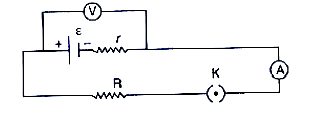
The diagram below in Fig. 8.40 shows a cell of e.m.f. ε = 2 volt and internal resistance r = 1 ohm to an external resistance R = 4 ohm. The ammeter A measures the current in the circuit and the
voltmeter V measures the terminal voltage across the cell. What will be the readings of the ammeter and voltmeter when (i) the key K is open, (ii) the key K is closed.

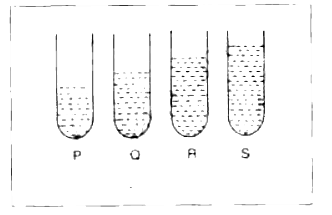
In fig. , P, Q, R and S represent test tubes each of height 20 cm which are filled with water upto heights of 10 cm, 14 cm, 16 cm and 18 cm respectively. If a vibrating tuning fork is placed over the mouth of test tube Q, a loud sound is heard.
(i) Describe the observations with the tubes P, R and S.
(ii) Give the reason for your observation in each case.
(iii) State the principle illustrated by the above experiment.
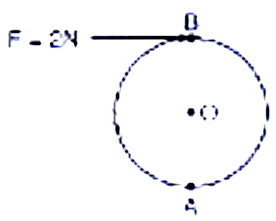
A wheel of diameter2 m is shown in the figure with the axle at O. A force F = 2 N is applied at B in the direction shown in the figure. Calculate the moment of force about Centre O and point A.