Question
Name two precautions to be observed while using an immersion heater.

Answer

The two main precautions to be observed are:
(i) Never try to find the temperature of water by dipping your fingers in water because some times when water comes in contact with the live or neutral wire, there is a possibility of getting an electric shock.
(ii) The heater must be surrounded by water to the desired level before it is switched on. If not,
so the heat produced in the nichrome wire will not dissipate easily and so the heating element will melt.

Need a full question paper?

Generate a complete, print-ready paper with questions like this in minutes — across 16+ boards, with answer keys.
Start Generating Free

Similar questions

What happens to the atomic number of element when (i) An $\alpha$-particle, (ii) $A \beta$-particle 1 and (iii) $\gamma$-radiation is emitted?
A light ray suffers reflection and refraction at the boundary in passing from air to water. Draw a neat labelled ray diagram to show it.
A ball is placed on a compressed spring. What form of energy does the spring possess? On releasing the spring, the ball flies away. Give a reason.
The speed of light in diamonds is $125,000\ km s ^{-1}$. What is its refractive index? (speed of light in air $=3 \times 108\ ms^{-1}$ ).
50 g of metal piece at 27°C requires 2400 J of heat energy so as to attain a temperature of 327°C . Calculate the specific heat capacity of the metal.
A man of mass $50 \ kg$ climbs up a ladder of height $10 \ m$. Calculate: (i) the work done by the man, (ii) the increase in his potential energy. $(g = 9.8 m s^{-2})$
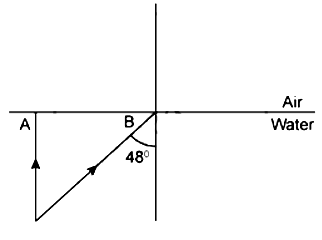
In following figure , show two rays A and B travelling from water to air. If the critical angle for water- air surface is 48°, complete the ray diagram showing the refracted rays for each. State conditions when the ray will suffer total internal reflection.
How will you decide whether a given piece of glass is a concave lens, convex lens, or a plane glass plate?
Water falls from a height of 50 m. Calculate the rise in the temperature of water when it strikes the bottom.
$(g = 10 ms^{-2}$​​​​​​​; Specific heat capacity of water $= 4200 J / kg^\circ C)$
Three heaters each rated 250 W, 100 V are connected in parallel to a 100 V supply. The resistance of each heater