Question
"Natural selection and speciation leads to evolution." Justify this statement.

Answer

Natural selection is the phenomenon by which the nature selects those species which possess survival advantage over the other species. According to theory of natural selection, there is "struggle for existence" within the species of a population for the environmental resources and this struggle leads to survival of certain organisms and elimination of the less competent species. Thus, in this competition, some organisms might undergo genetic changes which help them in their survival. The better adapted organisms would, thus, survive and pass on their traits to next generation, gradually leading to evolution.
Speciation is a process of formation of new species from the existing one due to reproductive isolation of a part of its population. This reproductive isolation can occur due to geographical isolation of a part of population.
With time, the genetic drift will accumulate different variations in each of the geographically separated sub-populations. Ultimately, all the individuals of these two groups will isolate reproductively, thus, leading to formation and evolution of new species. Thus, we can say that both natural selection and speciation lead to the evolution of species on earth.
Need a full question paper?

Generate a complete, print-ready paper with questions like this in minutes — across 16+ boards, with answer keys.

Start Generating Free

Similar questions

Why does micelle formation take place when soap is added to water? Will a micelle be formed in other solvents like ethanol also?
  1. Define the following terms:
(i) Valency. (ii) Atomic size.
  1. How do the valency and the atomic size of the element vary going from left to right along a period in the modern periodic table?
In which form is the 10% energy available for transfer?
Compare the nervous system and endocrine system (hormonal system) for control and coordination in humans.
The image of an object formed by a lens is of magnification - 1. If the distance between the object and its image is 60 cm, what is the focal length of the lens? If the object is moved 20 cm towards the lens, where would the image be formed? State reason and also draw a ray diagram in support of your answer.
Explain the process of preparation of soap in laboratory.
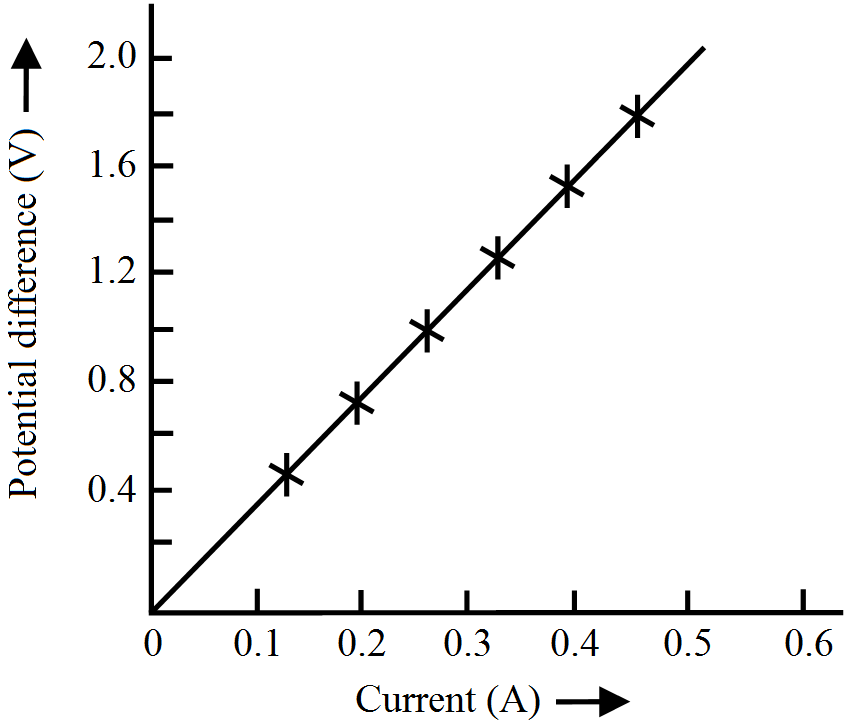
A V-1 graph for a nichrome wire is given below. What do you infer from this graph? Draw a labelled circuit diagram to obtain such a graph.
A cross was made between pure breeding pea plants, one with round and green seeds and the other with wrinkled and yellow seeds.
a. Write the phenotype of $F_1$ progeny. Give reason for your answer.
b. Write the different types of $F_2$ progeny obtained along with their ratio when $F_1$ progeny was selfed.
How $H _3 O ^{+}$ion is formed in water solution?
  1. An object 3cm high is placed 24cm away from a convex lens of focal length 8cm. Find by calculations, the position, height and nature of the image.
  2. If the object is moved to a point only 3 cm away from the lens, what is the new position, height and nature of the image?
  3. Which of the above two cases illustrates the working of a magnifying glass?